The Truth Needs No Defense
What the world desperately needs today is not a defense of the truth, but the proclamation of the truth.

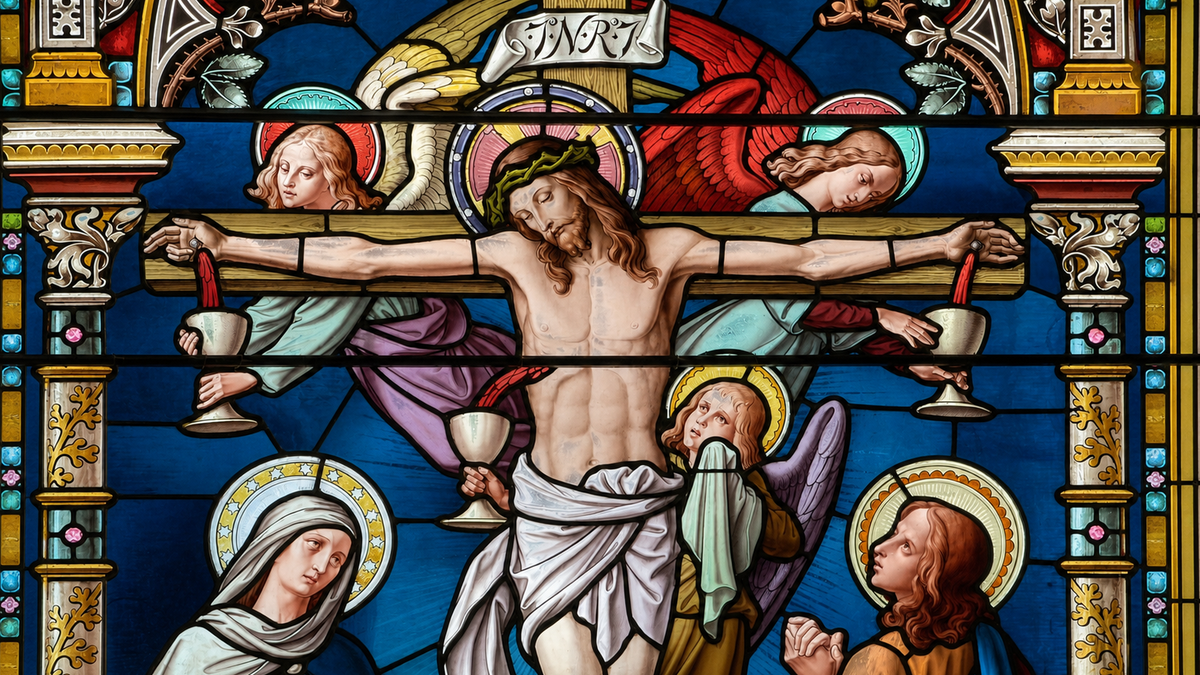
[B]ut we proclaim Christ crucified, a stumbling block to Jews and foolishness to Gentiles, but to those who are called, Jews and Greeks alike, Christ the power of God and the wisdom of God. (1 Corinthians 1:23-24)
The line between a principled defense of the truth and a descent into the abyss of ideology is thin, and in the heat of the moment, it fades fast. Modern life, it sometimes seems, consists of little more than a series of heated moments. Social media is full of “hot takes,” responding to ephemeral news, but even the release of Magnifica Humanitas, Pope Leo XIV’s 46,000-word encyclical on artificial intelligence and Catholic social teaching, which should have elicited considered reflection before any public discussion, was greeted with “initial reactions” by people who unabashedly declared that they hadn’t yet read it.
Sometimes, a quick reaction may be justified. Some things are so obviously wrong or obviously right that there is no need for anyone whose conscience has been properly formed to engage in a lengthy internal analysis before acknowledging that truth. Prejudice has taken on almost entirely a pejorative connotation, but the original meaning of the word was positive, describing the healthy response of a well-formed mind and soul in the face of particular circumstances requiring a quick judgment.
The pejorative connotation, however, has arisen for good reason, and not just because it has been used by those on the political and cultural left to short-circuit any discussion that might threaten their agenda. Just because a well-formed mind and soul may be capable of rendering a judgment that is not only correct but quick does not mean that everyone who renders a quick judgment has a well-formed mind and soul. A “hot take” today is just as likely (and perhaps more so) to reflect unexamined and even contradictory principles or, worse yet, unacknowledged desires or vices.
A few decades ago, it was a commonplace to say that “everyone has an ideology,” a more or less coherent set of principles or beliefs that forms his or her worldview. Depending on one’s own worldview, this or that ideology may be considered “good” or “bad.” Marxism was a bad ideology, in the eyes of ideological capitalists, and vice versa.
John Lukacs, Russell Kirk, and Eric Voegelin all argued explicitly that ideology is, at best, a deformation of the truth, a form of reductionism that, on the surface, becomes more coherent as it abstracts from the reality of human experience, and other thinkers such as Owen Barfield, Walker Percy, and Ortega y Gasset explored that reality in their own ways. Lukacs was fond of saying that “a half-truth is worse than a lie,” and the power of all ideologies is that each contains enough elements of the truth that those who fall into that particular ideological way of thinking can convince themselves that those elements are more important than any errors in their worldview that others might point out. They aren’t defending what others perceive as lies and distortions; they are defending what they perceive as the truth.
The truth, however, needs no defense.
Such a statement, I fully acknowledge, sounds ridiculous in a world in which all truth is under relentless attack. For Christians in particular, stating that “the truth needs no defense” may seem tantamount to ceding this world once again to the forces of darkness that Christ defeated through His death and resurrection.
But it is precisely because “the strife is o’er, the battle done” that we should know that the truth needs no defense. What the world desperately needs today — what it has always needed — is not a defense of the truth, but the proclamation of the truth. And yes, there is a difference.
One can defend the truth in a logical sense without actually knowing it, in the fullness of that word — that is, in the sense of experiencing and living the truth. Presumably, if you paid a clever (and I chose that word carefully) atheist like Richard Dawkins enough money, he could mount a spirited defense of Christianity. (Indeed, about a decade ago, Penn Jillette, an avowed atheist, put Piers Morgan, a professed Catholic, to shame in an interview when it became clear that Jillette understood the Catholic Faith better than Morgan.) But if Dawkins were to do such a thing, we should not make the mistake (as some did at the time of Jillette’s exchange with Morgan) of thinking that it means that he’s on the verge of repentance and conversion.
Anyone can mount a more or less coherent defense of the truth with just the skills he or she learned in high school debate. But he cannot proclaim the truth without having experienced it. Proclamation requires the deliberate intention to hand on the experience of the truth. For Christians, that means, above all else, the experience of our encounter with Christ. This is tradition in the fullest sense of the word, which Josef Pieper reminded us is not a set of principles or practices but the transmission of the experience of the truth that underlies and animates those principles and practices, an experience that may in fact call us beyond those practices (and perhaps even into a revision of those principles) as we are drawn more deeply into the mystery of the truth.
And this is where the defense of the truth may give way to ideology, should it become separated from the experience of the truth. When we mistake the principles and practices, the axioms and abstractions, for the underlying truth that they were meant to encapsulate and express, we risk turning them into an idol that comes between us and the experience of the truth.
The truth needs no defense, and because of our fallen nature, when we attempt to defend the truth rather than to proclaim it, we may find ourselves obsessing over the state of the wineskin, rather than drinking deeply of the wine it contains.