Footsteps and Memories
The dead still speak, if we have ears to hear.

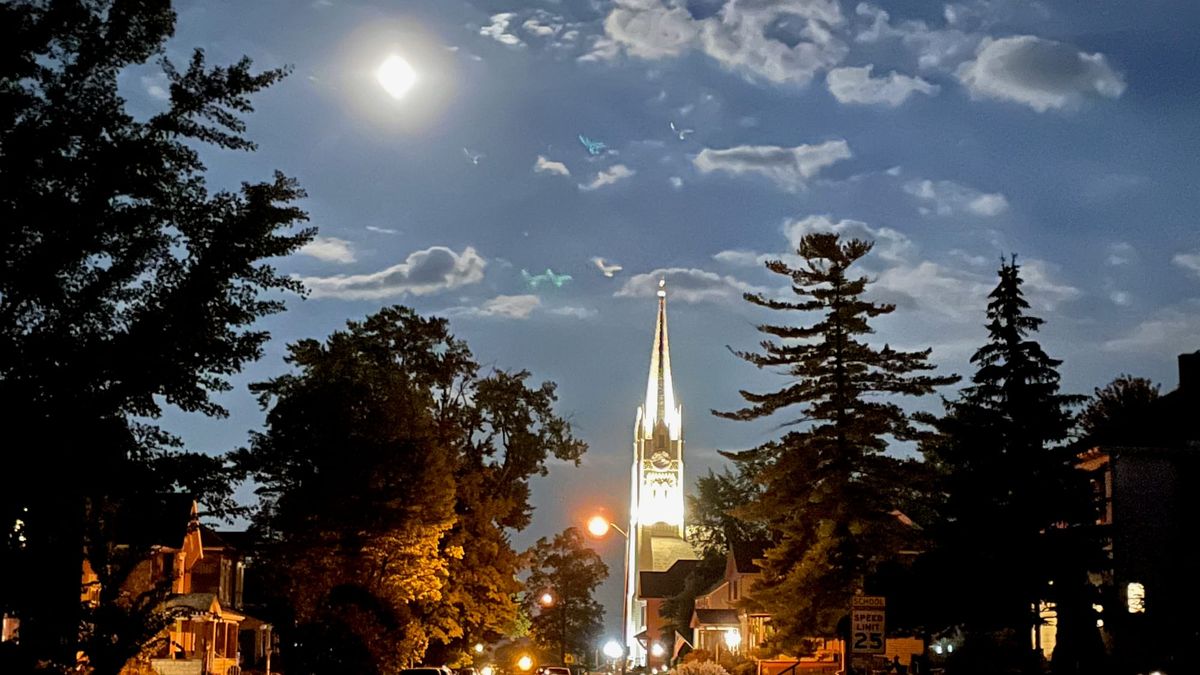
We called the block on which I grew up the “Big Block.” Through little quirks of history — mainly because of the placement of Holmes Elementary School and Spring Lake Junior/Senior High School — some of the lines on the planning grid never turned into streets. Two of the streets were there, but they became “courts,” dead-ending into the school grounds.
The perimeter of the Big Block is about 1.1 miles. In my teen years, I walked it nearly every night, usually at twilight or later. At first, it was a way to settle my thoughts. Over time, it gave rise to new ones.
The city of Huntington, Indiana, where we live now, is roughly seven times the population of my home village in Michigan, but it’s still walkable. When we moved here in 2017, we knew we wanted to be able to walk to downtown, to walk to work, to walk to church. We purchased a house just a half-mile north of the southern edge of downtown and right between Huntington’s two Catholic churches: Go out the front door and turn right, and you’re at Saint Mary’s; go out the back door and turn left, and you’re at Saints Peter and Paul.
Walkability is often viewed as a measure of quality of life, and it is that. But one of those new thoughts that occurred to me over 40 years ago as I walked the Big Block night after night is that walking isn’t just better for you than driving or (on the flip side) a less efficient means of transportation. Like reading a book or cooking a meal or attending a liturgy, walking forces us to slow down and to notice things that we cannot see even when we are obeying a 25-mph speed limit. And unless we are completely self-absorbed, when we start to notice such things we begin to wonder and to imagine how they came to be, and to think about those who came before us.
It seems obvious that the time and space through which we have passed present a hard boundary to our memories. But is that really true? Most of us have had the experience of remembering something that we couldn’t possibly have been present for or aware of at the time — something from the first year of our lives, or an incident that happened to one of our parents or siblings that seems so real to us that we can’t believe we didn’t experience it ourselves. Similarly, when we read a book, we’re encountering people and events through the words — and thus the thoughts — of the author, and his or her experience, and not just our experience of reading the book, in some way becomes our own.
Imagination, as much as reason (and perhaps even more than reason), is central to what we call consciousness, and what John Lukacs termed “historical consciousness” is an expression of the reality that memory is imagination extended through time. If, as five centuries of modern philosophical, political, and economic thought has claimed, each of us were truly an “individual,” completely contained within the boundaries of our own body and mind, we would never be able to understand one another. We don’t have to comprehend how consciousness works and what gives rise to it to recognize that my consciousness and yours must be more than some byproduct of cellular activity in our separate bodies: That is clear from the fact that we can understand each other when we communicate. But our communication with others does not have to end when they die — and I’m not talking here of the eternal existence of the soul.
The traces we leave in the physical world; the continued existence of that house or the emptiness of this lot because the home that was there was torn down; the words we write and the photographs we take or appear in — all of these become fodder for our imagination and the extension of our memory beyond the time and space through which we have traveled. One does not have to believe, as I do, that man was created by God and that our souls are eternal to walk into SS. Peter and Paul and recognize that every detail of the church in which I am writing these particular words communicates something from those who created the stained-glass windows, painted the statues, chose quarter-sawn oak to bring out the beauty of these pews.
For those who have eyes to see and ears to hear, the dead still speak to us, and their communication becomes a part of our memory.
A day later, I am writing this paragraph in a blond-wood pew after the 8 A.M. Mass at Saint Mary’s, the parish where Fr. John Francis Noll was pastor when he founded the newspaper Our Sunday Visitor. The intricately carved high altar at which he celebrated Mass was replaced by a very modern metal structure over 70 years ago, long before the Second Vatican Council and the Novus Ordo came along. But Father Noll’s presence is still palpable in the surrounding neighborhood, in houses built in a Southwestern style with tiled roofs, an architectural oddity everywhere in northern Indiana, except in Huntington. Out on the west side of town, Saint Felix Friary and Victory Noll share a similar style, reflections of Father Noll’s interest in the mission of the Sisters of Our Lady of Victory, who sent religious to the Southwest to catechize the Native Americans.
I’ve walked nearly every inch of the grounds of Saint Felix, where Blessed Solanus Casey spent the last decade of his life before returning to Detroit during his final illness. He died on July 31, 1957 — one year to the day after Archbishop Noll passed into eternal life. (“Nothing by coincidence; everything by divine providence,” as Fr. Tony Steinacker, the current pastor of Huntington’s two Catholic churches, often says.) It’s a short walk from Saint Felix to Victory Noll, where Archbishop Noll is buried among the sisters he so loved. Their order is dwindling now, and the remaining members have moved to a Methodist retirement home in Warren, Indiana, but of the handful of sisters who remain, some are old enough to remember Archbishop Noll 70 years after his death.
The memories go back even further in this town. Before Amy and the children joined me, I spent my first five weeks here at the Purviance House, an historic bed-and-breakfast run by Barb and Brooks Fetters, who was at that time the mayor of Huntington. Several nights a week, I walked across the Little River from the south side of town to the Rusty Dog, a tavern with an Irish flair and Southern-tinged menu on the first floor of the main building of the Milligan Block, named after Huntington attorney Lambdin P. Milligan, a Copperhead and member of the Knights of the Golden Circle whose name used to be familiar to every student who took high-school civics but now is mainly recognized by other lawyers because of Ex Parte Milligan, the Supreme Court decision that prevented the trial of civilians by military tribunals when civilian courts were still in operation, thus saving the right of habeas corpus from the attempt by President Lincoln and Congress to suspend it. The Rusty Dog was owned by a lawyer, too, who had little in common with Milligan but doubtless approved of the Supreme Court decision.
Mayor Fetters understood the importance of walking, though he prefers a bicycle, and during his administration, the city constructed a network of walking and biking trails. Huntington has seven separate National Register Historic Districts, and each has its own character and history. As you walk them, if you know what to look for, you can still pick out the corner stores and taverns, now converted into residences, that would have been centers of community life back before that neighborhood joint Applebee’s and family grocer Kroger came to Huntington.
Downtown, Nick’s Kitchen was no doubt visited more than once by Archbishop Noll and even Solanus Casey, but it’s more famous as the restaurant where the breaded pork tenderloin sandwich was invented by the eponymous Nick and where Dan Quayle announced every one of his bids for public office, because his father, the publisher of the Huntington Herald-Press, held court there every morning. (Nick’s menu features many different varieties of potatoes, but no singular potato.)
Above the downtown, on North Jefferson Street, Huntington’s businessmen and bankers built stunning Gothic mansions and Victorian and Queen Anne-style houses, and one “Stick Style” house (an intermediate style between Victorian and Queen Anne) that my family and I call home. Before we ever made an offer on the house, I learned that it had a name. Amy, with her background in museum management and historic preservation, was excited, until I revealed it was the Julius Dick House. She no longer wanted to put a sign in the yard or a plaque on the porch, but we did learn all we could about the Brothers Dick, who owned a department store downtown and parlayed their profits into investments in utilities throughout the Midwest. Julius’s wife, Sarah Frances (nicknamed “Frank”), made the front page of the New York Times when she became the first female bank vice-president in the country.
The rise of 24-hour news and social media and now AI has wreaked havoc on our memories. A constant rush of “information” offers little opportunity to synthesize it all, much less exercise our imagination. Our lives are more “efficient,” but 40 years ago, in August 1986, walking the perimeter of the Big Block, efficiency was the furthest thing from my mind. As I was heading to Michigan State University that September, all that mattered to me was capturing the essence of my village, my world up until then, that I might carry it with me for the rest of my life.
My memories are connected to footsteps, and always will be.
The Countermarch is a labor of love. If you found this essay thought-provoking or useful, please consider supporting the site.