I Have an Idea
How do I know? I wrote it down.

I use AI to generate computer programs that help me get things done. LLMs have proved to be useful tools to create one-off solutions to problems that may be specific to just one person. I suspect that, with a little more polish, the scheduling and reminders app that Claude and Codex have written for me could be helpful to others, and perhaps even something that I could sell. What matters, though, is not its commercial potential but that my work is more organized because of it. I’ve tried nearly every such app over the years, and none of them checked all of the boxes for me. This one does.
I use AI to create websites that I couldn’t create otherwise. LLMs are getting better every day at visualizing data in bespoke ways. I use these websites in my consulting business, where every client has different data sources and sets and different needs. Some of these websites might have broader commercial uses if I made them more generic. But I don’t have to worry about monetizing them broadly, because the cost of creating and maintaining and customizing them for my clients is so low. I can serve my clients better by not turning these websites into commercial products.
I don’t use AI to write essays for me. Every word that you read on The Countermarch made its way from my mind to my fingers to my keyboard to my laptop screen to the screen on which you’re reading it. But that is just the external shape of the process. Having written and published somewhere north of two million words over the past 35 years, I have become a quicker writer than many. I’m no Stephen King or even a Scott Sigler, but if I know what it is that I want to say, I can turn the first draft of a 1,500-word essay in about an hour. (And because I have made a living as an editor, that first draft may well be minutes away from being the final one.)
That’s not to say that I find writing easy. I don’t. But the hard part isn’t the external process. The hard part is found in these words: “if I know what it is that I want to say.”
We’ve all heard people claim, “I have a great idea, but I don’t know how to express it.” You have a sudden intuition, or you hear a phrase that seems loaded with meaning, and your mind starts working away at it, but it always seems just out of reach. Eventually, you give up, and you tell your friend or coworker, “I had a great idea, but I lost it.”
I haven’t said those words since the early 1990s, but before that, I uttered them more times than I care to count. Why the early 1990s? Because that’s when, as a graduate student in political theory at The Catholic University of America, I first came across an insight from the Italian philosopher Benedetto Croce that explained this experience: We do not truly have an idea until we have expressed it.
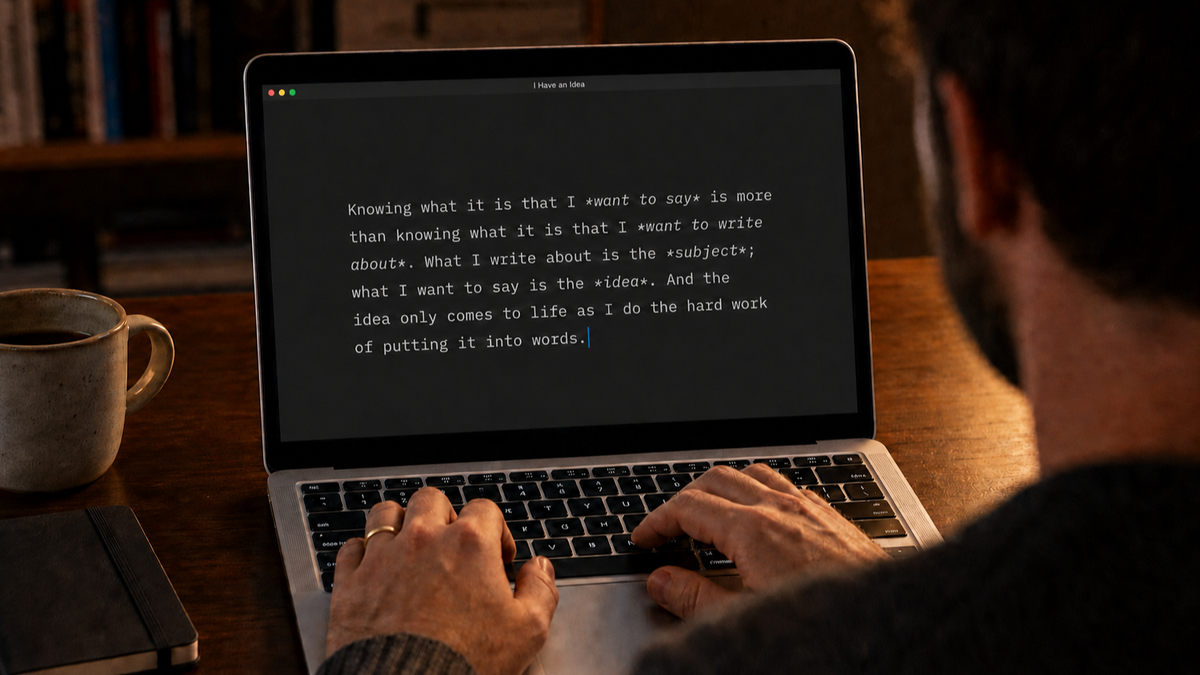
Knowing what it is that I want to say is more than knowing what it is that I want to write about. What I write about is the subject; what I want to say is the idea. And the idea only comes to life as I do the hard work of putting it into words.
This essay is about the debate that’s raging now on social media (especially, interestingly, on LinkedIn) over whether generating text through an LLM is the same as writing. What I am about to express, however, are my thoughts on that proposition: that is, what I want to say.
I do not deny that most ideas start with an intuition. Indeed, I would go further and say that every idea starts with an intuition, but that’s a different essay for another day. When we have an intuition, we grasp something, whether tenuously or firmly. Having an intuition usually means that we have seen a connection between two disparate things that feels like it reveals some truth that we didn’t know before.
If an intuition stops there, however, it never fully coalesces into an idea. That’s where the all-too-common experience of thinking that we have had an idea but lost it arises. When we get to the point where we give up trying to express it and declare the idea lost, the intuition itself has usually (though not always) faded away. Something has indeed been lost, but it was not an idea.
For me, Croce’s insight has applied mostly to words: There is no idea until I have written it down, or spoken it out loud to someone else, or at the very least voiced it in my head. (And of those three, only writing it down ensures that the idea will continue to exist, because spoken words and internal monologues are both ephemeral.) But while my medium for expressing an idea is words, for others it might be oil paints, or marble carving, or woodworking, or music. The medium is less important than the reality that, for an intuition to become not just my idea or your idea but simply an idea, the person who had the intuition must be able to express it.
This unbreakable connection between an idea and its expression is why using AI to generate text that you will present as your own isn’t the same as writing. It has nothing to with “elitism” or “snobbery” among professional writers (though, alas, some of the arguments being made by writers on social media against the use of AI to “write” come across that way). It has everything to do with the qualitative difference in process between watching an LLM fill up a computer screen by generating the next most likely word based on the billions of connections between all of the words that the LLM ingested during its training, and a writer filling that same screen with the words through which he or she is fashioning her inchoate intuition into an actual idea.
But wait: Doesn’t my application of Croce’s insight to AI give the lie to itself? After all, when someone instructs an LLM to “write” something for him, the prompt consists of words, whether typed or (increasingly, with ChatGPT Live) spoken. If there is no idea until it is expressed, isn’t the prompt itself the expression and therefore the idea?
We can certainly say that prompting an LLM to write an essay about X, or a short story about two people who do Y, is expressing the barest idea about what you want the text to be. But the whole point of using the LLM to write is that you not only expect but intend the LLM to go beyond the bare idea you have expressed. And because you haven’t expressed it, anything the LLM generates beyond that bare idea — argument, examples, essay structure, story plot, descriptions of characters and scenes, dialogue — isn’t your idea or your work.
It is perhaps easier to understand the difference between the text that an LLM generates based on your prompt and the essay or story that you have written yourself if we look at other media through which we express ideas. I have no artistic talent whatsoever (likely a result of my aphantasia), so I will never be able to express anything more complex than driving directions or mechanical instructions through any artistic medium, but I have used ChatGPT to generate images based on my essays, and I have posted them with my essays on The Countermarch and on social media.
If I were to ask you if one of those images is mine, you might say yes. After all, I wrote the essay and prompted the LLM to generate the image based on my text. If that doesn’t make the image mine, who does it belong to?
But if I asked you if I drew the image, you would almost certainly say no. The LLM generated the image; I drew nothing (which is why I clearly label all such images as AI-generated in the alt text when I post them). I have taken genuine delight in some of the images that ChatGPT has generated based on my essays, and every one that I have chosen to post illustrates something I have expressed in the essay to which it is attached. But I have not drawn any of them, and to claim otherwise would be a lie.
Why, then, would anyone say that he has written a story or an essay when an LLM has generated the text? Set aside those people who know that they are making a bad-faith argument. The charitable explanation is that those who think of AI-generated text as their writing have been misled in a similar way to those who have become convinced that LLMs are conscious or may someday become conscious. Just as an AI’s use of language as a medium for the tokens it is generating creates an illusion of consciousness, so our use of language in prompting an LLM to write an essay or a story contributes to the illusion that what the LLM has generated in response is our idea fully expressed, rather than extended pattern matching based on the combined corpus of hundreds of millions of other people.
I have used the terms essay and story as shorthand for any text[1] whose purpose is to express something new, to bring an intuition to life as an idea. But there are uses for AI-generated text that fall into a different category. For instance, I use ChatGPT to generate parts of contracts that I send to clients. There’s nothing new about legal boilerplate, and I have no desire to claim anything in the fine print as my idea rather than the ideas of legislative staffers and bureaucrats. I use local LLMs to generate daily and weekly reports of my work, transcribe meetings, and capture tasks that I might otherwise forget. I dread filling out government forms and dealing with automated customer-service chatbots, and now I don’t have to (though I do check everything before I hit send).
What do all of those uses of AI-generated text have in common, besides not being passed off as my own work? They free up my time to read more and to think and to write essays like this one, to turn intuitions into ideas through the hard work of choosing words and shaping sentences and crafting arguments until both you, dear reader, and I know what it is that I want to say.
No LLM will ever be able to do that for me — or for you.
E.g., speeches, novels, screenplays, poems, lyrics, treatises, books, and so on. ↩︎
The Countermarch is a labor of love. If you found this essay thought-provoking or useful, please consider supporting the site.