Tick Tock
A story of time

He was 58 when he realized where the time had gone. Not in the sense that most people mean when they use that phrase: He knew why the years had flown by, how he had spent his time and how he had wasted it. Projects started and never completed; eight-hour days at the office that turned into twelve, thirteen, fourteen. Driving a Zip drive full of InDesign files and artwork and ads to the UPS depot at O’Hare every month for over a year before realizing that he could drop the magazine pages at the Rockford airport instead if he and Aaron wrapped up the issue by eight PM.
Once the internet was fast enough that they could upload the files to the printer in Michigan, the pressure was off, so of course he and Aaron started ordering pizza or sushi and made an evening of it as they put each issue to bed later and later. One Groundhog Day they finished right at the stroke of midnight, only to find that the blizzard that had been rattling the office windows all evening had piled snow three feet high in the parking lot. They had ordered no food because they had been trying to get home early (or so they told themselves and their wives), so they dug around in desk drawers and found a couple of pieces of jerky, one expired protein bar, and some long-forgotten liquor. They divided the spoils of their foraging and toasted the issue they had just sent to press.
He and Aaron offered the same toast every month, at first alternating but eventually saying it in unison. The words they used had first been uttered by their boss and editor-in-chief, who jumped straight out of his chair every day at exactly five PM as his wife beep-beeped the horn of their far-from-gently used VW when she drove past his office window. Rushing out into the hallway as his office door slammed, he’d yell, “Anyone here?” He always acted surprised when they both shouted back, “Yes!”
The toast had been born one day when their boss returned from lunch, pulled his advance copy of the latest issue from his office mailbox, and, with a weary sigh, muttered to no one in particular, “It just keeps coming out.”
The toast complete, they poured a second round and a third and went to sleep in their office chairs. When they woke the next morning, there wasn’t a cloud in the steel blue sky and the snowdrifts sparkled like glitter in the nine AM sun, but six hundred miles away, Punxsutawney Phil couldn’t see his shadow.
While his work expanded every day to fit the time he thought he had, his wife gave birth to their children, who kept growing and growing and growing, and set about homeschooling them. They uttered their first words, took their first steps, made their First Communions and confirmations and graduations as he told himself, whenever he was late for a milestone, that he was not just putting a roof over their heads and food on the table but was, through his writing and editing, helping to build them a better world.
Such are the everyday regrets of nearly every husband and father, cat’s in the cradle and the man in the moon and all that. But that wasn’t what he realized that Sunday morning in August, as he tossed his iPad, on which he had been reading a lecture by Ray Bradbury on finding your personal metaphor, on his wife’s side of the bed and glanced at his watch to see how late he would be for Mass. (He wore a smartwatch every day and night to help him stay on time and in shape; after eleven years, he weighed fifty pounds more than when he’d bought his first one.) As he rose from their bed (his wife, he knew, was already halfway to church), his iPhone, charging in nightstand mode on his dresser, caught his eye.
He looked down at his wrist and back at the phone, then checked them both once more to make sure his eyes weren’t deceiving him. They weren’t.
And suddenly he knew, with the certainty of the centurion when the earth quaked and the veil of the temple was rent in two, where the time had gone.
He also realized that, until that very moment, he hadn’t been aware that any time had gone anywhere, or even that it could, except in that silver spoon, little boy blue, Harry Chapin kind of way.
And he knew one thing more: His life had changed forever.
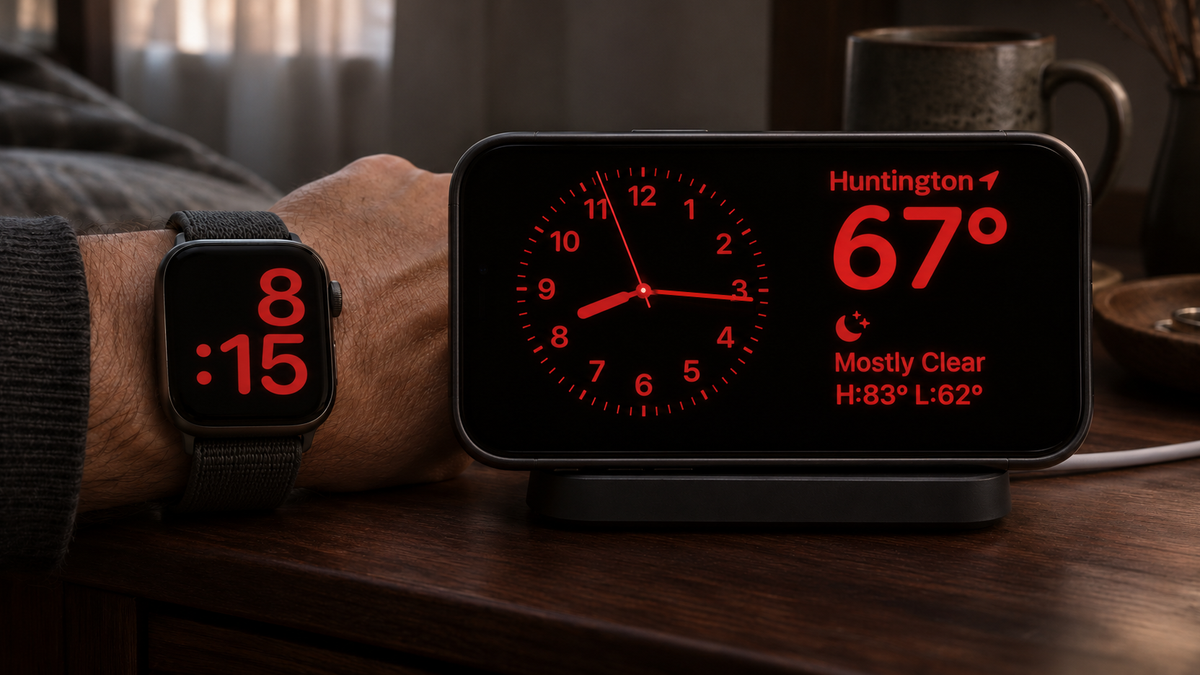
He looked at his watch again. There was the time, in big red numerals: 8:15. The colon faded in and out, steady as a heartbeat, but the numbers were solid, immutable. He held his wrist up alongside his phone, its face also in red, the long second hand sweeping the perimeter of the clock and the short hour hand pointing just a little past the numeral 8.
The minute hand, though, was what held his eye. The two devices were paired, so there was no question that they were in sync; but while the watch told him with the certainty of round numbers that it was 8:15 and therefore he had enough time to shower and brush his teeth and dress and follow his wife’s footsteps down to SS. Peter and Paul and walk up the center aisle and genuflect and slide in the pew beside her before the cantor announced the number of the opening hymn, the clock on the phone told an entirely different story.
The minute hand was clearly past the 3, on its way toward the 4, 5, and 6, while the second hand was sweeping upward from the bottom of the dial.
Time stood still at 8:15 on his wrist, but on his phone it was racing toward 8:30. He had to rush now if he were to make it to Mass before the organist struck the first chord and the priest and the altar servers began to process down the center aisle and he had to sneak up the side and slide into the pew at the other end and step over his children so he could sit by his wife, who would smile at him with tight lips while her forehead scowled because he was late, again. He might even have to skip brushing his teeth, because the electric toothbrush took exactly two minutes to run through its cycle, and that could make all the difference.
He realized with a start that he was still standing between his bed and his dresser, contemplating his discovery. Move it, move it. He pulled off his watch and slapped it on the charger, quickly made the bed, stripped off his pajamas, turned on the shower to warm up the water, downed his morning pills, jumped in the shower while it was still lukewarm, and all the while his mind was racing a million miles a minute.
But what was a minute? The concept suddenly felt foreign, though he couldn’t recall a time (ha!) when he didn’t know the word. Schrödinger’s cat (he realized with a chill — or was it just the shower?) had nothing on 8:15. The cat had only two possible states, alive or dead. But those three red numerals on his Apple Watch — they could be 8:14:59 plus one second or 8:16:00 minus one, or any of sixty thousand milliseconds in between. And observe as he might, he could never kill or save the electronic cat, because this 8:15 was not this 8:15 was not this 8:15 and now it’s 8:16 and the cat is no longer alive or dead but simply gone, replaced by a dog or a raccoon or a possum. (Did they have possums in Schrödinger’s Austria?)
A sudden memory: not of a possum or even the skunk he once came nose-to-nose with while on his hands and knees searching for something in his parents’ shed, but of a classroom clock or rather all of the clocks in every one of his classrooms through elementary, junior high, and high school, all exactly the same, white face, black numerals, sweeping second hand. And once again he focused on the minute hand. Unlike the digital-analog (or was it analog-digital?) clock on his iPhone or the wind-up watches he’d worn as a child, the minute hand on every one of those classroom clocks moved all at once, jumping from this minute to that as the second hand passed 12.
No: That wasn’t quite right. It didn’t just jump: It moved backward first, halfway between the tick it was on and the previous tick, and then it slingshotted over the tick it had been on and came to a halt on the next tick, where it sat for a full minute (or fifty-nine seconds? fifty-nine and a half? he was no longer sure) before traveling back in time once more so time could move forward again.
Was that why school days had seemed so excessively long? Time expanded in the classroom, moving not just forward but backward, each minute rewinding a bit of the past before charging into the future.
He turned the water to cold, stood under it as long as he could (why did a few seconds in a cold shower seem longer than minutes in a hot one?), leaped out, toweled down, weighed himself, and without thinking brushed his teeth, only realizing when he was done that he had burned two minutes he had intended to save. His mind had been mulling over another clue: He had recalled the sound of the clock in the classroom, a tock before the tick, as the minute hand moved back before moving forward. And that reminded him of the pendulum on the clock in the living room of his childhood home, the house where his father still lived, though the clock was long gone and the only time that remained was on the LCD face of the combination VCR/DVD player, the colon fading in, fading out while the white numbers stood still as his father watched FOX News or old movies late into the night.
He remembered that pendulums had something called a moment. Was that significant? He wasn’t sure because he couldn’t recall what it was. The second hand moved forward as the pendulum swung to the right — tick — but nothing happened as it swung back to the left — tock. Or did it? Did the leftward swing reverse time, expand time, as the classroom clocks had done? Was that why time moved slower when he was young?
He’d read once that the feeling that time moved faster as you aged was just a matter of scale, because each additional unit of time — second, minute, hour, day, a week, a month, a year — made up a smaller and smaller fraction of all of the time you had experienced. But he knew that could not be right, because there were still summer days that lasted forever, evenings on the porch with family and friends, good meals and better conversation, time spent reading and writing and praying and making love to his wife that lasted longer than it should at his age unless —
His mind seized on the possibility: unless reading and writing and praying and making love were the tock of the classroom clock, the leftward swing of the pendulum, the expansion of time that countered the tick tick tick of work and responsibilities and cellular decay, the creative energy that held the entropy of the universe in check.
What had Saint Augustine said when he tried to explain how God, Who existed outside of time, had brought time into existence? Something about time being marked by the beating of angels’ wings. A wing isn’t a pendulum but its motion is similar, back and forth, back and forth. A tock and a tick.
Even most philosophers today would still admit that Augustine was brilliant, ahead of his time, so perhaps the beating of angels’ wings was Augustine’s personal metaphor, tying time not to the literal motion of the literal wings of literal cherubim and seraphim but using those celestial beings to represent the entire created world. Then again, Augustine believed in angels and thought that God had created them before any other beings, so maybe he did mean it literally.
He threw on his clothes and his socks and his shoes, strapped on his watch, and dictated some of these thoughts into his iPhone as he rushed down the stairs, grabbing his hat from the hook on the back porch on his way out the door.
He was halfway across the lawn when he saw his neighbor Nate puttering in his own backyard. He owed Nate a hundred dollars, his share of the cost of the dumpster they’d rented together, and the disposal company had left a queen-sized mattress on the ground when they hauled the dumpster away. Good fences make good neighbors, but Nate had torn their fence down a few weeks ago so there was no avoiding him, and now he was certain he would be later than ever, coming in the door to the last strains of the last verse of the opening hymn. At least he would be able to walk up the middle aisle because the procession would already have passed, but he dreaded the look he knew he would see on his wife’s face.
He kept walking as Nate talked, and now he was out of Nate’s line of sight, a garage in between them, and as he called out “See you later!” he realized that his train of thought had slipped down a siding while he was distracted. He had read H.G. Wells’ Time Machine when he was ten or eleven and the pulp novels and TV shows and movies of his youth had relied, as did Wells, on mechanical contrivances to rip their heroes from this moment in time and catapult them into the distant past or far-flung future. But over the years he had come to prefer the time travel in Jack Finney’s Time and Again or Richard Matheson’s Somewhere in Time or even that story in Bradbury’s Martian Chronicles in which the astronauts find themselves living in their own past on Mars because the Martians had read their minds and projected memories of the homes and families of their youth, the old oak and the front porch and the sweet and savory smell of the pie cooling on the kitchen windowsill. Falling in love with a woman in a sepia-toned photograph and getting so lost in imagining the past that you wake up one morning and open your bedroom door and find yourself there — really truly there — appealed more to his imagination than dials and levers and blinking lights and beep beep boop flash gone.
His train of thought rounded a bend, and passages from Owen Barfield and Coleridge came crashing into his mind. Before imagination, there was inspiration.
Inspiration. Inspire. Breathe in. Tock.
Expiration. Expire. Breathe out. Tick.
Analog watch. Classroom clock. Back swing. Tock.
Digital watch. VCR. Forward swing. Tick.
This was where the time had gone. For years his life and the lives of everyone he knew had been all tick, no tock. Breathing out, never in, tick tick no tock, until he was winded, until time had expired, no rest, no rewind, no timeless moment at the bottom of the pendulum when the only way to know which way it would go was to know the way from which it had come.
But if you already knew the path the pendulum had traveled, you knew where it would go, its direction as well as its position, so it could not be simultaneously this and that, back and forth, but must already be determined. If Heisenberg were right, you couldn’t be the observer, even though you were the one watching the clock. The observer must be someone else — one of Augustine’s angels, perhaps? — and you and the clock were inside Schrödinger’s box, observed yourself, alive because observed. Tock. Until you were observed to be no more, tick no tock, like a ticking time bomb, tick tick BOOM. Time, like an ever-rolling stream ...
He was halfway up the center aisle before he realized that he hadn’t heard the two-minute warning, the church bells that rang at 8:58 every Sunday before he had left home or at the latest on his walk to Mass. He genuflected, slid into the pew, and glanced at his wife before kneeling to pray. As he made the Sign of the Cross, he realized her smile was true.
An Act of Contrition offered and intentions made, he sat back on the pew and glanced at his watch: 8:56. He hadn’t been to Mass this early in months. A laugh welled up inside of him but came out only as a contented sigh. He knew the secret now. He knew where the time had gone, and now he could get it back. Pressing the screen on his watch, he swiped left, changing the face to analog.
He took a deep breath. Tock.
As he looked over the hymns for the day (two good, one tolerable, and one he wouldn’t sing), his wife sighed — but not at him! — and he looked at his watch again. The minute hand read 9:02, on its way to 9:15. Father Tony must be saying Mass.
In the sacristy, Father Tony finished vesting, pulled up his sleeve, and checked his watch. The red numerals sat unmoving as the colon faded in, faded out: 9:02.
Late again.
Tick.