Solzhenitsyn’s Single Purpose
A review of Love the Revolution

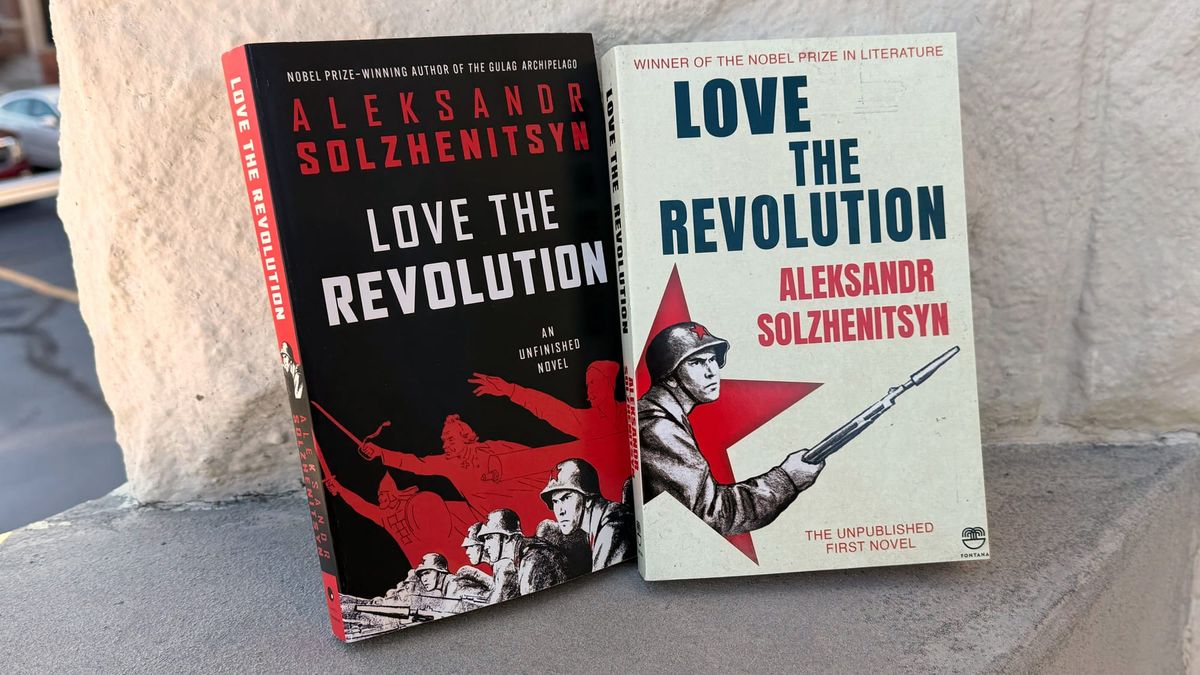
It is not every day that a major work by a Nobel Prize-winning author is published for the first time in English. Nor that an author’s first work of fiction, written nearly eighty years before, is published in English for the first time almost twenty years after his death.
November 17, 2026, however, is such a day. Love the Revolution, Aleksandr Solzhenitsyn’s first (though unfinished) novel, written mostly in 1948 (twenty-two years before he was awarded the Nobel Prize for Literature and twenty-six before he was stripped of his Soviet citizenship and exiled from the Soviet Union), has been released worldwide by Harper Perennial and Fontana (in the United Kingdom and Commonwealth countries), in a vibrant, contemporary-feeling English translation by Alexis Klimoff and Michael Nicholson.
Before I go any further, a quick disclosure: I am not a disinterested party, and not just because, if you click on the Bookshop.org links in this essay, I will earn a commission on any purchases you make. Since mid-2022, I have been working with the Aleksandr Solzhenitsyn Estate and the Librairie Arthème Fayard (which handles the underlying rights) as the English-language rights manager for Solzhenitsyn’s works. Love the Revolution is one of a number of projects I have been privileged to assist the Estate in bringing to fruition and among several to be released over the next few years that should lead to a resurgence of interest in Solzhenitsyn’s work and establish his continuing relevance for our time.
If you haven’t read Solzhenitsyn in a long time, or perhaps have only read such works as his 1978 Harvard commencement address, A World Split Apart, Love the Revolution is a good (re)introduction to his fiction. The title is taken from the book’s epigraph, a bit of dialogue uttered by a French revolutionary anarchist in Boris Lavrenyov’s 1923 short story, “Marina”:
Love the revolution, my boy!
In the whole world it alone is worthy of love.
To our ears today, these lines may sound farcical, but Lavrenyov meant them seriously, and, at one time, Solzhenitsyn did, too. Solzhenitsyn’s prose, both fiction and nonfiction, has such power because, before he was a dissident, he was a true believer, who volunteered for the Red Army in 1941 motivated by Marxist-Leninist ideology rather than (as many Russians did) in response to Stalin’s (possibly pragmatic; possibly more primal) evocation of Russian nationalism.
That tension appears early in the first chapter of Love the Revolution, when Gleb Nerzhin, the novel’s autobiographical protagonist, on a train to Moscow to continue his studies, reflects that “life was wonderful,” because he had
the great good fortune to be born in the best of all lands, one whose historical crises all lay behind it, a land already organized on the scientific principles of reason and social justice. This unburdened his mind and conscience from any need to defend the unfortunate and the oppressed — for there were none to defend.
But Gleb also muses that the name Russia, after having been cast aside in 1922 when the country had officially become the Union of Soviet Socialist Republics, was beginning to reemerge. And while “There was something vaguely flattering and evocative about the word,”
the feelings it aroused were unfocused and obscure, even galling when its images of incense and cypress smoke, of thatched huts and birch trees, were used to block out the word “Revolution,” so fresh, so young, and so suggestive of pulsating new blood.
War, Gleb knew, was coming (though he could hardly know how quickly), but he did not foresee a Great Patriotic War; rather he and his
whole generation had been born for a single purpose — to take this Revolution, which already covered one sixth of the globe, and to spread it across the entire face of the earth.
Gleb arrived in Moscow the morning of Sunday, June 22, 1941 — the very day that Operation Barbarossa, the German invasion of the Soviet Union, began. All that he had known — he was born in 1918 (as was Solzhenitsyn) — was about to change forever.
Solzhenitsyn first conceived of Love the Revolution as a much longer novel entitled The Story of One Artillery Battery, which would cover his experiences in the Red Army throughout the war. By the time that he began to write it in 1948, however, he had been arrested, convicted, and sentenced in 1945 to eight years of forced labor for writing letters critical of Stalin, and his rethinking of his “ideology-induced willful blindness to reality” had begun.
That last quotation comes from Alexis Klimoff’s Introduction to Love the Revolution, which provides important context for understanding the novel; tells the remarkable (essentially miraculous) story of how the original manuscript survived Solzhenitsyn’s transfer from intellectual labor in a prison laboratory to a forced-labor camp in Central Asia in 1950; and discusses the likely reasons why Solzhenitsyn never finished the work after recovering the manuscript in 1956. The main reason — the tension between Solzhenitsyn’s rejection of his (and therefore Gleb Nerzhin’s) youthful ideology and the fiction writer’s need to tell a story from within — has, I believe, implications for the future of public discourse in the United States. As our latter-day ideologues across the political spectrum may discover should they, like Solzhenitsyn, someday come to grips with their own “ideology-induced willful blindness to reality,” it is often easier to forgive those you once viewed as your enemies than it is to forgive yourself for your own errors.
Despite its subject matter, its setting, and its remove from us in time, Love the Revolution is a quick read. A hundred or more explanatory endnotes provide additional information when the reader wants it, without interrupting the flow of the story. Photos of Solzhenitsyn when he was young — during his student years, the war, and at the time he wrote the first draft of Love the Revolution — and a biographical timeline provide glimpses into portions of Solzhenitsyn’s life that many readers may not have experienced before.
Love the Revolution is the first of many Solzhenitsyn volumes to come — never-before translated essays and speeches and new translations of a number of his most important works, including one which has also never been available in English (at least in authorized translations) and others that have been significantly revised and offer additional material because they are based on the final, authorized Russian texts. As we approach 2028, the one hundred and tenth anniversary of Alexander Solzhenitsyn’s birth and the twentieth anniversary of his death, his prophetic voice is once again calling us back to reality.
That, not the Revolution, was truly Solzhenitsyn’s “single purpose.” Let’s pray we have ears to hear.
Scott’s Personal Recommendation
A great introduction (or reintroduction) to the fiction of Aleksandr Solzhenitsyn, available for the first time in a vibrant and accessible English translation that transports the reader back to the early days of Russia’s entry into World War II.