Conceiving the Inconceivable
Learning to think outside of our mental box

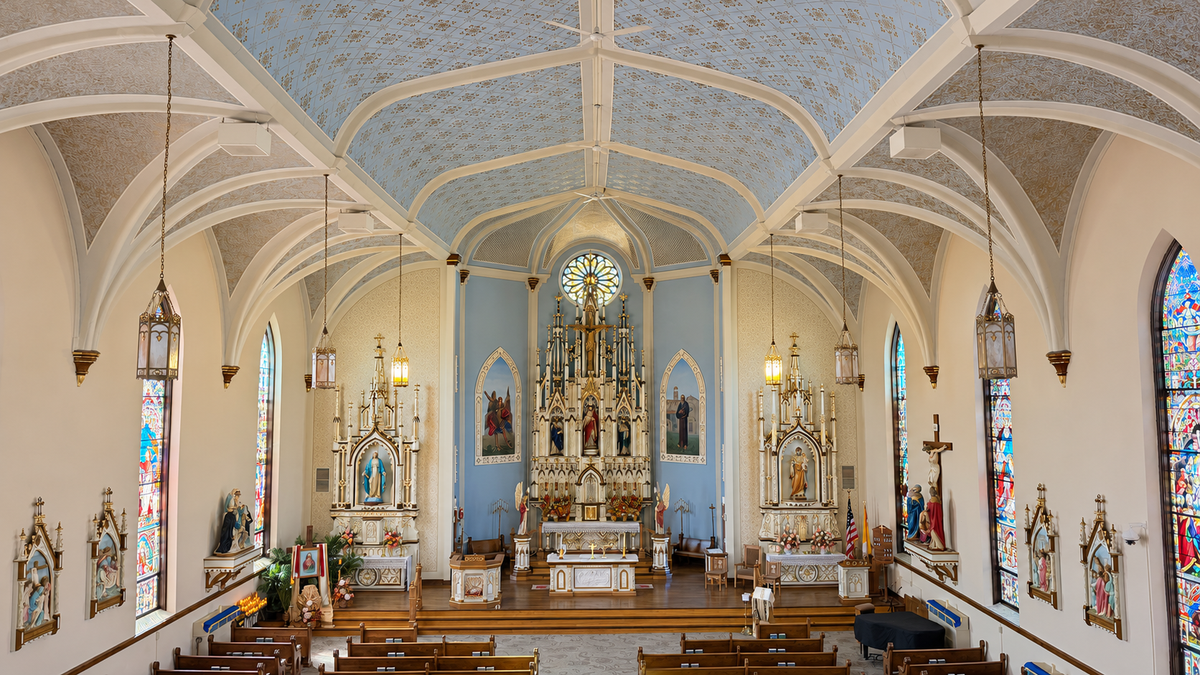
I am sitting in the sanctuary of SS. Peter and Paul Catholic Church in our city of Huntington, Indiana, as I write this. The church bell just rang once. I know that means it is 10:30 AM, but you could not have known that from the six words of the previous sentence. In all likelihood, when you read that sentence, you did not even stop to consider what that single peal of the bell meant — perhaps not even whether it signified a particular time; certainly not what time it signified. Had I not called your attention to those six words, you might even have forgotten them by now. How could that sentence be anything more than an insignificant detail in an essay that you are beginning to hope actually has a point?
When I first arrived in Huntington in June 2017, SS. Peter and Paul was already a beautiful church. But Fr. Tony Steinacker, who became pastor six days after I arrived, has spent considerable time, effort, and money in making it even more so. One of the few parts he hasn’t touched is the ceiling of the church, the center portion of which, stretching all the way from the wall behind the high altar to the opposite wall behind the choir loft, has an unusual shape, like the hull of a shallow boat turned upside down.
In October 2017, my sisters and our families took my parents on a cruise from New York City up the coast of New England and on to Canada to celebrate their fiftieth wedding anniversary. In Halifax, I visited a church that had a strikingly similar ceiling — not quite as shallow, but bearing the unmistakable shape of a hull. A pamphlet on the history of the church explained that the ceiling was, for all intents and purposes, exactly that. When the church was built, the craftsmen at the Halifax shipyard constructed the frame for the ceiling the same way they built the hull of a ship. Structurally, it serves that purpose just as well.
Not long after we returned from our cruise, we went to the museum at the Forks of the Wabash here in Huntington. The exhibits include an abundance of information on the history of the Wabash and Erie Canal, which was built to connect the eastern Great Lakes and the river systems of the northeastern United States across the Great Portage of northern Indiana to the Ohio and Mississippi River systems.
Among the exhibits is a scale model of a canal boat. Even if you have never seen the ceiling of SS. Peter and Paul or the model of the canal boat at the Forks of the Wabash, you will no longer be surprised when I tell you that the hull of the canal boat is the exact shape of the frame of the ceiling.
SS. Peter and Paul was built in the early 1840s. Construction on the Wabash and Erie Canal began in 1832 and was completed in 1853. The canal ran through the center of Huntington, a little more than a quarter of a mile downhill from the church. Some of those who moved here to work on the construction of the canal were among the first parishioners of SS. Peter and Paul.
As I wrote the last few paragraphs, the church bell rang eleven times. The last six words of the previous sentence almost certainly struck you in a different way than “The church bell just rang once” did. I didn’t have to tell you what time eleven strikes signifies, and you didn’t have to think about it; you just knew. That knowledge is part of the mental framework that holds your world together, just as the canal-boat-shaped frame of the ceiling of SS. Peter and Paul defines the current limits of my upward gaze.
Just because my gaze cannot penetrate the ceiling, however, does not mean that there is nothing beyond it. Occasionally, I think about what might be up there, and I’m sure that other parishioners and visitors to the church sometimes do, too. But most of the time, our thoughts rise no further than the curved white ribs of the ceiling frame and the blue and gold pattern painted on the panels between them.
We know what we know, and we don’t know what we don’t know. But how do we know that we know what we know if we don’t know what we don’t know? Sometimes, when we come to know something we didn’t know, it calls into question what we were certain we knew before; and sometimes it makes us realize that we hadn’t even considered what we now know until we came to know it.
Before we have them, such thoughts are literally inconceivable. (Cue Wallace Shawn in The Princess Bride.) No matter how clever and observant and free-thinking we may believe ourselves to be, every one of us spends most of our lives thinking inside the box that the interplay of our culture and our experience has created for us. We may acknowledge that there are possibilities outside of the box, but the box tends to keep us from seeing them, especially if those possibilities might call into question our unthinking assumption that the box in which we live is all there is to know, and all we need to know.
I am writing these words during Adoration, with the Body, Blood, Soul, and Divinity of our Lord Jesus Christ on display in the monstrance on the low altar here at SS. Peter and Paul, looking for all the world like a flat, round, white piece of unsalted and unleavened bread. But the cognitive dissonance between the accidents of the Host and the substance of the sacrament is not what I am writing about today. Nor is this a plea for us to heed the words of St. Thomas Aquinas: Praestet fides supplementum sensuum defectui (“What our senses fail to fathom, let us grasp with faith’s consent”).
I have something more mundane in mind.
One of the recurring themes in the essays in Wendell Berry’s Dispatches from Rural America is the inability or unwillingness of people to think outside of their mental box. When speaking of particular people, especially in the longest essay in the collection, “Foreign Relations: A Dispatch from Rural America” (as well as one of the shortest, “Barn Raiser”), Mr. Berry leans mostly toward an unwillingness born of self-interest and at least a bit of fear. Those whose livelihoods and intellectual reputations depend on making sure that no one looks behind the curtain have a powerful incentive to ignore, dismiss, or attack anyone who might prove them a humbug, as Mr. Berry deftly demonstrates in interwoven responses to two essays written by two very different men and published two decades apart in The New York Review of Books.
At other times, though, and particularly when speaking of the common worldview that most Americans share and have shared for so long that we no longer consider it consciously, Mr. Berry recognizes that the problem is closer to an inability to think otherwise: We cannot conceive the inconceivable. In his essays “The Problem Is Industrialism” and “Technological Progress,” Mr. Berry examine the mental determinism that has resulted from the interplay of the Industrial Revolution, the rapid advances in technology in recent decades, and five centuries of Western philosophy and culture in thrall to the modern conception of “progress.”
The Catholic historian John Lukacs, with whom Wendell Berry struck up a correspondence in 2008 that lasted until Lukacs’s death in 2019 (detailed in the essay “A Surprising Friendship”), often wrote that, contra Karl Marx (and, I would add, modern libertarians), our economic structures are a consequence of what we think, and not the other way around. Of course, the economic systems that arise from the way we think tend to reinforce those ways of thinking, making them habitual, and just as every true habit (bad or good) eventually becomes something we do without thinking about it anymore, those ways of thought recede into the background until they become part of the walls of our mental box.
When Wendell Berry and his friend Wes Jackson, the founder of the Land Institute, come to the conclusion in a long telephone conversation that the problem that underlies most of our other problems is industrialism, they aren’t speaking as Luddites who think that the answer is as simple as turning over machinery in factories and taking sledgehammers to a half-million-dollar combine harvester in the field. Industrialism is a way of thought that has its roots in an early modern understanding of “progress” that turned on its ear the classical and Christian recognition of, and respect for, human limits and the natural limits of the world in which we live. The shift in scientific thinking from the expansion of understanding of God’s creation to the manipulation and control of nature, the development of technique and technology, added to the concept of progress the idea that “growth” is mostly inevitable and always desirable.
And because progress is good and growth is good, and the recognition (much less the imposition) of limits is bad, when new technologies result in “unintended consequences” the answer is always, as Berry notes, more technology. There is, we assume, no problem that one technology creates that another technology cannot solve. That the creation of new technologies to solve the problems created by earlier technologies results in “economic growth” is just more proof that the system works, so it never even enters our minds to question whether an unending cycle of “solutions” that create more problems is truly in the best interest of society and the created world.
We see this playing out in real time with the mad rush to develop and deploy more and more advanced AI systems. OpenAI, Anthropic, and other AI frontier labs have explicitly stated that the systems they are developing not only may create significant problems for which we currently have no solutions but are already doing so. We have no need to worry, however, because these same companies, which have a vested economic interest in moving forward as quickly as possible, assure us of something they cannot possibly guarantee or even know: that the systems which are currently creating problems will also create more advanced AI systems that will solve those problems.
The only sane approach, therefore, is to accelerate the pace of AI development so we can solve those problems more quickly. Anything else is inconceivable, because if newer technologies cannot solve the problems created by older technologies, then we may never solve those problems, and we know with the certainty of scientific faith that that’s not how technological progress works.
When some public voices do call for a more cautious approach, they are labeled Luddites or worse: Peter Thiel accused Pope Leo XIV of being an unwitting tool of the Chinese Communist Party and perhaps the anti-Christ because he raised concerns about the dangers of AI in Magnifica Humanitas. Thiel, of course, has investments in well over a dozen AI companies, but he also assumes that growth is inevitable and inherently good, and if Pope Leo’s concerns convince Western governments to regulate AI development, the Chinese government will continue to move forward as rapidly as possible, putting the West at risk.
But what if growth isn’t inherently good? In a woman’s body, a new life growing in the womb is one thing; a lump growing in her breast is quite another. When a boy grows taller from birth to his late teens, we recognize it as a sign of health; if he continues to grow past his mid-twenties, his growth is more likely a sign of a condition that needs to be treated before it shortens his life.
In many essays over the decades, including in this latest volume, Mr. Berry has suggested that health is a more, well, healthy principle by which to measure new technologies and the potential “progress” they may offer — not the metaphorical “health” of a company’s bottom line or a nation’s GDP, but the actual health of people, communities, and the natural world of which those people and communities are a part. He has often used, as a concrete example, the way in which the Old Order Amish consider whether and how to integrate new technologies into their communities, weighing not only the potential benefits but also the possible damage it may do to their relations with one another, with the land, and with God.
Like Mr. Berry, I have always found that example instructive, but I have also recognized (as surely he must have) that the image most people hold of the Amish is of a community so “backward” and “anti-progress” that it is not possible for non-Amish to conceive of their approach to technology as the Amish themselves do, in positive rather than negative terms. Because of our unflagging faith in technological progress, we can only conceive of the non-use of a new technology as a deprivation rather than, potentially, a choice to preserve something more important that the technology might destroy or undermine.
Mr. Berry has usually spoken of the Amish making their choices in terms of community, but for the Amish, as for all Christians, community is not an end in itself. The health of a community is measured by how it serves our personal and communal relationship with God. (Nowhere has Mr. Berry made that more clear than in his essay “David Kline’s Day Book” in Dispatches from Rural America.)
From the mid-1990s to the mid-2010s, I frequently argued that there are no political solutions to cultural problems. About 2015, I finally came to realize that there are no cultural solutions to cultural problems, either. (I can, on occasion, be a slow learner.) The mental box in which we have placed ourselves — with its unquestioned assumptions that progress is inevitable, growth is always good, every limit can be overcome, and newer technology is always the answer to every problem that older technology creates — is a cultural problem. And the only answer to cultural problems is a religious one.
In nature, good growth is only one part of a healthy ecosystem. Decay and death are just as important, because they make the soil fertile ground for new life.[1] Our First Parents refused to live within the limits of the world God created for them. Death, as Saint Ambrose wrote, restored those limits, so that new life might be possible:
The Lord allowed death to enter this world so that sin might come to an end. But he gave us the resurrection of the dead so that our nature might not end once more in death; death was to bring guilt to an end, and the resurrection was to enable our nature to continue forever.
The limits of nature, the limits of our nature, help us to understand the life that we were created to live. The limits we impose on ourselves through our unquestioning acceptance of the idea that there should be no limits to our desires, that growth is always good and can continue forever without decay and death, that material progress rather than moral and spiritual progress is the measure of a society’s health (and thus of the health of each member of that society), and that such “progress” will never create problems that further “progress” cannot solve — these limits, paradoxically, can only be overcome by recognizing and accepting the limits we did not create.
Only then might we see the walls of our mental box for what they are and begin to conceive of ways of living that our ancestors might recognize as the natural extension of the best parts of the lives that they lived but which are, for us, currently inconceivable.
Industrial agriculture is founded on the implicit refusal to accept the idea that decay and death are necessary for healthy growth. Decades of reliance on chemical fertilizers as a substitute for the nutrients that cover crops and manures traditionally provided has led, as Mr. Berry has noted for years, to the erosion and exhaustion of much of the best farmland in the United States — a form of death from which there is no resurrection. ↩︎
Essays in this series
 Scott P. Richert

Continuing the great conversation
 Scott P. Richert

Inspired by the essay “Against the Killing of Children” by Wendell Berry
Scott’s Personal Recommendation
I am engaging Wendell Berry’s posthumously published book of essays through a series of essays of my own. Grab a copy, sign up for the newsletter, and join the conversation in the comments on “Walking with Wendell Berry.”