Remotely Present
Placing work at the service of life

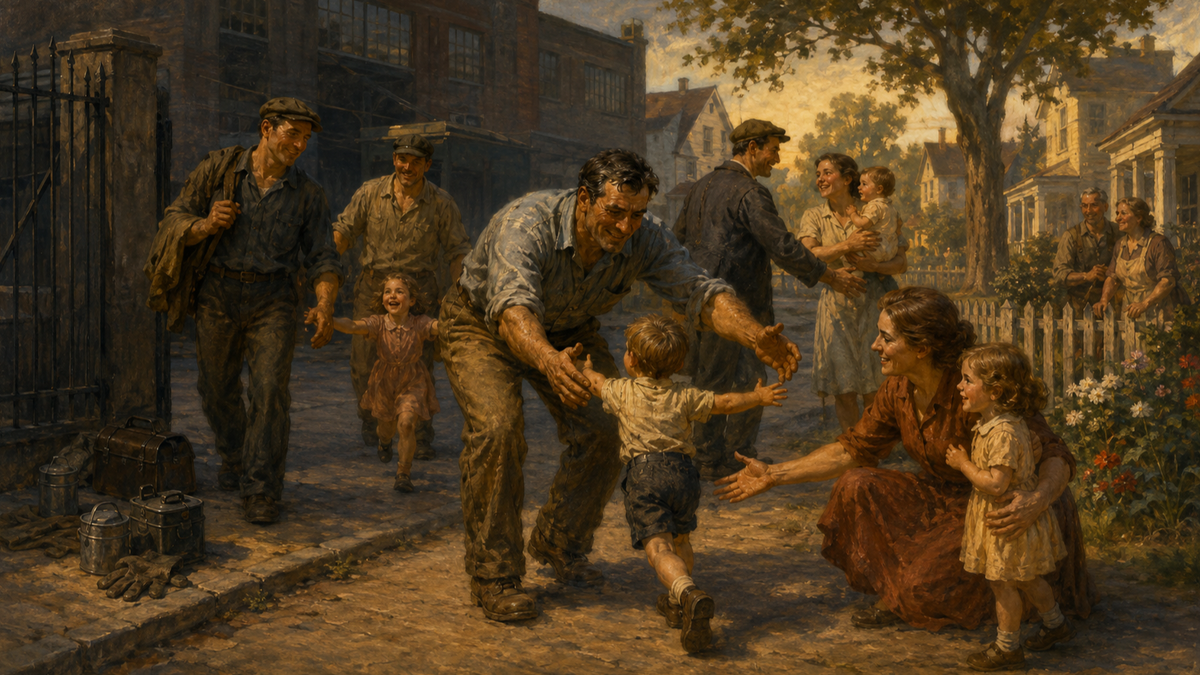
Why do we work? Ask a hundred people, and you may get a hundred different answers. But they will probably all fit into one of a few buckets:
- to put a roof over my family’s head and food on the table
- to pay the bills
- to save for a day when I no longer have to work
- because I enjoy what I do
- because I wouldn’t know what else to do with my time
They’re all reasonable answers, as far as they go; but are they really the reason we work?
Perhaps one of the hundred you speak with might be of a poetic, philosophical, or theological bent and so reply that, “In Adam’s fall, we sinned all,” and the sweat of our brow is part of the price we pay. That’s certainly closer to the ontological reality of work, but it still doesn’t go quite far enough. When God cast Adam and Eve from the Garden and told them that they would have to till the ground, He didn’t say, “The life you had before is entirely over; forget everything We have told you until now.” While work is the result of the fall, it must be ordered to the same ends that Adam and Eve were supposed to pursue before the serpent led them astray: to walk with God; to delight in His creation; to be fruitful and multiply and be stewards of the earth.
Josef Pieper, of course, points in this direction in Leisure, the Basis of Culture. But even he did not state it as plainly as Anthony Esolen does in Out of the Ashes: Rebuilding American Culture. The question we should ask ourselves, Esolen argues, is
not what work we do for a living, but what work we do for a living: how to work in the light of day, for the sake of life, rather than subjecting life to work, or defining yourself and your life in the terms of work.
I read Out of the Ashes in the summer of 2019 and reviewed it for Crisis Magazine that September. I had no way of knowing, of course, that in just a few short months, the way in which much of the world would work would be dramatically changed. For most people in the United States, that change occurred on Friday the 13th of March 2020.
Over six years later, “remote work” is no longer just a byproduct of COVID. Even those companies that have mandated a “return to office” have rarely demanded that their employees be in the office five days a week. Three seems the new norm, with both two and four close behind. Five is as much of an outlier as one.
Debates about the productivity and efficiency of remote employees will continue for years, because studies vary widely between companies and industries, and even within the same industry. What is more clear, however, is that the shape of remote workers’ lives changed, and those people who define themselves in terms of their work are more likely to want to return to the office, while those who found that working from home helped reorient their work “for the sake of life” have been more likely to resist such mandates. Not surprisingly, young mothers (and, to a lesser extent, young fathers) are heavily represented in the latter group.[1]
Throughout the 20th and 21st centuries, up until COVID, “going somewhere” in one’s career quite often literally meant going somewhere. “Upward mobility” meant geographical mobility. And geographical mobility meant breaking ties (or at least changing the nature of those ties) to friends and family, tearing up the roots you had put down in a particular place, turning the living, breathing reality of your life here among us into a photograph or memory of there and them that, over time, would fade.
And that pattern, repeated time and again, reinforced the idea that we live to work, not work to live. The first people you meet in your new town are probably not your neighbors but your coworkers. They might very well become friends and remain so while you work together, but their future will probably take them somewhere else, as yours did.
While remote work in some form is likely here to stay, six-and-a-half years after the start of the pandemic is still too soon to tell whether it will significantly reorient our approach to work and reduce the felt need for geographical mobility, allowing us to be present in our lives here while working remotely. What is clear is this: For many people, such a change in mindset is possible for the first time in nearly a century. But no longer feeling compelled to move is no giant leap but just the first step, and the smallest one, toward placing work at the service of life rather than life at the service of work.
To complete the reorientation that Esolen urges requires — ironically — hard work that, throughout all of history until recent decades, came more easily than it does to us, because it was not a choice: cultivating your corner of the vineyard by maintaining your house and land; getting to know your neighbors; taking an active part in the public life of your community, political, economic, cultural, and religious; and rearing your children to understand that all of these things do not take away from your work but are the very reason why you work.
Yes, in Adam’s fall, we sinned all, and must make our living now by the sweat of our brow. But Christ came not to give us more work to do but that we might have life and have it more abundantly. Most of our ancestors had no choice but to live rooted lives in communities that endured for generations. Most of us, however, not only have the choice but must choose, because not to choose is itself a choice to continue living to work, rather than working to live.
What will you choose?
There are also the “digital nomads,” primarily younger people with few family obligations or ties to a particular place, who have used remote work to travel here for a few months, there for a few months. For the most part, though, they are in industries that had embraced or at least tolerated remote work long before the pandemic, so the change in their lives has been less dramatic. ↩︎