Prudential Judgment and Just War
The Church’s teaching on prudence calls political leaders to a higher moral standard.

Over 50 years ago, in the early pages of Love in the Ruins, Walker Percy took certain trends he had recognized within the Catholic Church in the United States and exaggerated them — partly to comic and partly, alas, to prophetic effect.
A good novelist and a great psychiatrist, Percy understood that the mind of modern man has become captive to popular opinion — or, more broadly speaking, to the tendency, ever-increasing for over five centuries now, to subjugate all of life to politics. In Percy’s novel, the Catholic Church in the United States has split into three parts: one that took modernism to the extreme and traded faith for the ephemeral; one that combined nostalgia for tradition with American nationalism; and the smallest, which remained united with the Pope in Rome.
Throughout the rest of Percy’s life, that portion of the Church in the United States that resembled the modernists was on the rise; the traditionalists were mostly beleaguered and often quite skeptical of American nationalism, with some finding in the founding of the United States (not entirely unreasonably) the seeds of a Masonic conspiracy. Meanwhile, most of those who attended Mass (nearly) every Sunday continued to recite the Nicene Creed and mean it, so far as they understood it, while the actions of many Catholics (starting particularly with the last generation that came of age just before Pope John XXIII convened the Second Vatican Council) made it clear that what they actually believed increasingly diverged from the Church’s perennial moral and social teaching.
A lot has changed in the three and a half decades since Percy’s death. The older generation that had come to doubt the divinity of Jesus (and didn’t understand why it mattered anyway) mostly transitioned out of the Church or out of this life. A “John Paul II generation” of priests and converts brought a conservative intellectual, moral, and liturgical shape to the Church in the United States, and more Catholics, previously wedded to the Democratic Party, began to vote Republican, primarily because of moral issues such as abortion — even as divorce rates and contraceptive use among Mass-going Catholics continued to rise, no matter how they identified politically.
Somewhere around 2015 — starting perhaps a few years earlier, but solidly under way by then — a deeper change took place, and among laypeople and, increasingly, priests (especially, though not entirely, younger ones) and even a few bishops (though not as many as the last remnants of the Catholic left would have you believe), something closer in worldview, if not in external form, to Percy’s prophecy of a nationalistic American Catholic Church began to form.
Donald Trump was not the cause of it; more likely, the political views he adopted in order to get elected and those of more and more people in the pews and not a few men behind the altar were a reaction to a leftist zeitgeist that had passed through the dictatorship of relativism that Pope Benedict XVI had warned about on its way to social and mental incoherence. While Trump did not cause that shift among Mass-going Catholics, he benefited from it and rode the wave in both 2016 and 2024.
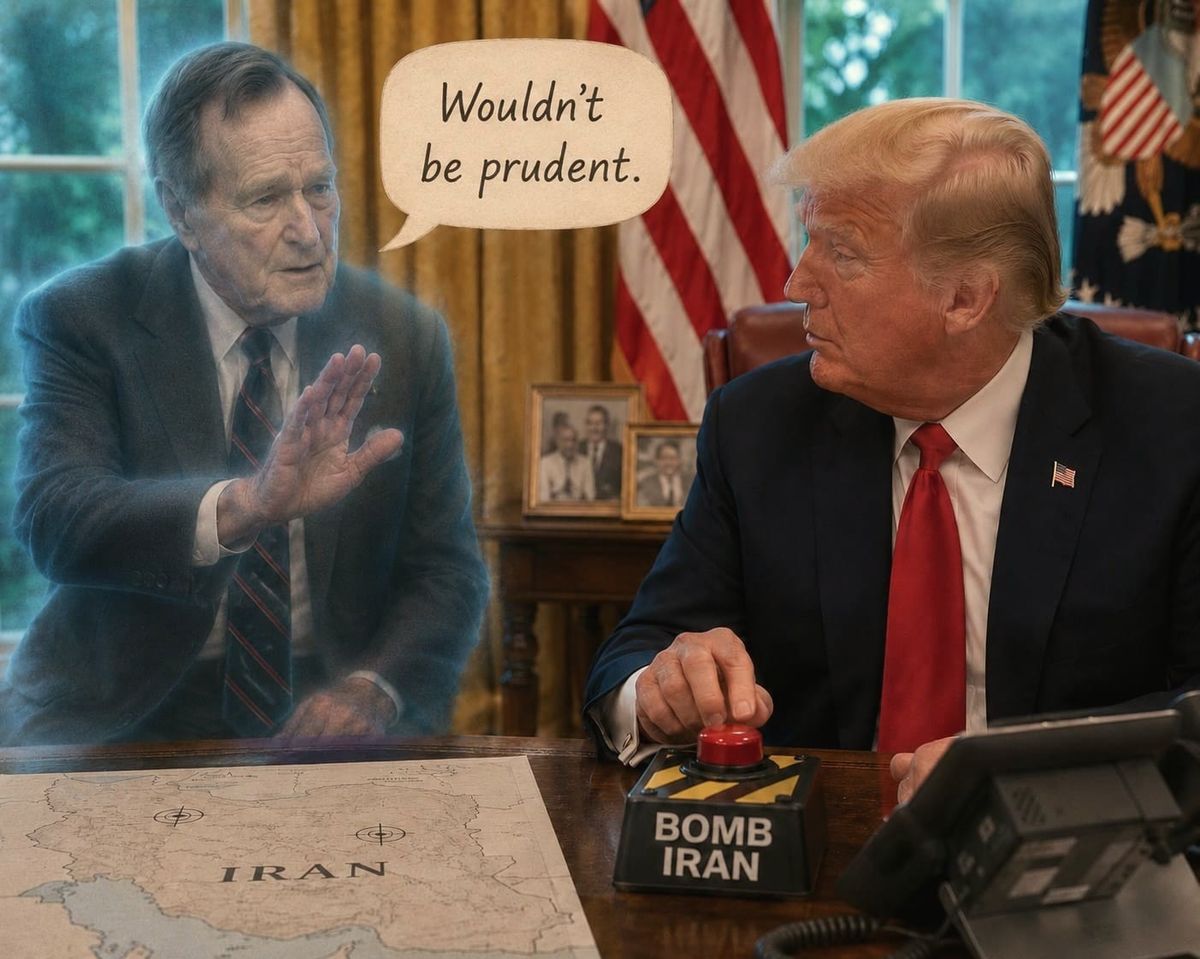
This quick (and thus necessarily rough) sketch of 50 years of American Catholic history provides a lens through which we can begin to understand the late unpleasantness between President Trump and Pope Leo XIV, particularly regarding the President’s ill-considered and ill-fated war against Iran. And it offers at least a partial explanation for the odd reality that, in the midst of the President’s attacks on the Pope, social media was filled with posts by fallen-away Catholics, not a few Protestants, and even a significant number of atheists who were praising the Holy Father for his unequivocal condemnation of the war and his calls for diplomatic efforts toward peace, while many (though by no means all) “conservative” Catholics who, a year ago, were energized by the election of the first American Pope and cautiously optimistic that Leo’s pontificate would follow a different path from Francis’s suddenly seemed possessed by the ghost of William F. Buckley, Jr., and began shouting the equivalent of “Mater si, magistra no!”
We had heard those same cries before — from Buckley himself and his circle in 1990, in the run-up to the Gulf War; and from Buckley again and Michael Novak and Richard John Neuhaus and James Hitchcock and other neoconservative Catholics in 2002 and 2003, as George W. Bush decided to finish what his father had deliberately left unfinished in Iraq. It’s all well and good, we were told then and are being told again now, that the Vicar of Christ calls for peace and reminds political leaders that the Church has, over more than 1,500 years, developed comprehensive principles to determine whether a war is just and, if so, whether its prosecution is being carried out justly; but the Pope must refrain from criticizing those political leaders who choose to wage war — especially (and, in practice, only) the President of the United States — because that decision, the Church herself declares, “belongs to the prudential judgment of those who have responsibility for the common good.”
In the case of President Trump’s attack on Iran, those words from the Catechism of the Catholic Church appeared all over social media after a prominent conservative American bishop (bucking the trend among his brother bishops) cited that line against those Catholics who opposed the war, and even made the rounds of the Sunday morning political talk shows to argue that Pope Leo’s invocations of just-war principles were meant “generally” and were not directed at the current occupant of the White House — a claim that was proved incorrect just a day or two later, when the Holy Father made it clear that he meant to apply those principles to this war, right now.
Still, Bishop Robert Barron’s reminder that the teaching on just war in the Catechism of the Catholic Church does not end with the list of the conditions that must be met could have served as a welcome extension of the discussion, had he explained what the Church means by the term prudential judgment. Instead, just as those Catholics who dismissed the opposition of Pope John Paul II and the future Pope Benedict XVI to the Gulf War and the Iraq War had done, Bishop Barron (and those who cited him) treated that phrase as if we should drop the adjective prudential and read it simply as judgment, while, in practice, defining judgment as “whatever decision the one holding the authority to wage war decides to make.”
But the adjective is, in fact, the most important word in the phrase. A prudential judgment is not the same as a “practical judgement”; it is, by definition, a judgment made in accordance with the dictates of prudence. To say that “The evaluation of these conditions for moral legitimacy belongs to the prudential judgment of those who have responsibility for the common good” means that, in order to claim moral legitimacy for a war they wish to wage, those who hold the authority to wage that war must first evaluate it according to the four conditions of just-war theory and, moreover, must exercise prudence in making that evaluation.
Paragraph 1806 of the Catechism outlines the Church’s teaching on the virtue of prudence, while the glossary in the back of the Catechism distills that teaching into a concise definition. Prudence is
[t]he virtue which disposes a person to discern the good and choose the correct means to accomplish it. One of the cardinal moral virtues that dispose the Christian to live according to the law of Christ, prudence provides the proximate guidance for the judgment of conscience.
Let’s set aside, for the moment, the fact that the Constitution endows Congress with the authority to declare war and accept that, for many decades now, Congress has ceded that authority to the President. That unfortunate inversion of constitutional duties does not change the reality that it is entirely possible, in Catholic moral theology, to hold the authority to make a decision and still make it wrongly. The President could, for instance, choose not even to consider the “strict conditions for legitimate defense by military force,” must less give them “rigorous consideration.”
Even if he does consider them, he must grapple first with the reality that, by definition, an offensive war is not “legitimate defense,” which is why, in the run-up to the war in Iraq, Cardinal Ratzinger repeatedly reminded the Bush White House and its emissary Michael Novak that “the concept of preventive war appears nowhere in the Catechism.” Even if the risible claim that Iran was two weeks away from striking the United States with a nuclear weapon (which Pete Hegseth eventually admitted to Congress was false but which President Trump continued to repeat) had turned out to be true, just-war principles would still require every possible diplomatic solution to be exhausted before military force could be considered.
But let’s be frank: There is no public evidence that President Trump took the strict conditions for just war into consideration before making his decision to attack Iran. The Catechism is clear: To disregard those conditions is the very opposite of exercising “prudential judgment”: “With the help of this virtue we apply moral principles to particular cases without error and overcome doubts about the good to achieve and the evil to avoid.” The conditions themselves are the guardrails within which prudence — “right reason in action,” as St. Thomas Aquinas defined it — operates. Unless a proposed use of military force is for “legitimate defense” and meets all four “strict conditions” for “moral legitimacy,” the decision to proceed can never be a proper prudential judgment.
While Michael Novak, Richard John Neuhaus, and James Hitchcock all supported the Iraq War until their last breaths, Bill Buckley expressed his regret for having done so. He couched his change of heart, however, in terms that we’re hearing again with regard to Trump’s war against Iran: No one could have known that it would go so wrong. But the truth is that there were those who knew and said so — Pope John Paul II and Cardinal Ratzinger chief among them — because they brought prudence to bear in their consideration of the justice of the war. That an unjust war led to disastrous consequences should have surprised no one, considering that even truly just wars result in death and destruction that takes generations to heal.
There is one major difference between the run-up to both the Gulf War and the Iraq War and the debates concerning Trump’s war against Iran: In 1990 and in 2002/2003, Bush Senior and Bush Junior took seriously the moral authority of Pope John Paul II and the Catholic Church. In 1990, George H.W. Bush attempted to convince the Vatican that the conditions for a just war had been met; in 2002/2003, his son tried (through the efforts of Michael Novak) to get John Paul to expand the Church’s teaching to allow for offensive wars under certain conditions (which occasioned Cardinal Ratzinger’s remark about preventive war and the Catechism).
In 2026, neither President Trump nor those around him seems to have thought desirable, much less necessary, to approach Pope Leo to make a moral case for the war in Iran. And President Trump’s most vocal Catholic supporters in the United States, rather than standing with the Holy Father, chose to attack Pope Leo for upholding Catholic teaching or, at best, to attempt to reduce his words to moral platitudes that imprudent politicians could choose to ignore.
Humility consists in large part in recognizing that we don’t know everything; that our actions, therefore, will often have consequences that we didn’t intend; and that, despite not intending them, we are still responsible for those consequences. That the humblest men are often the most prudent is hardly surprising; that those who lack humility are often astoundingly imprudent is even less so.