Of Sin and Conspiracy
Conspiracy theories in the age of Trump, Part 1

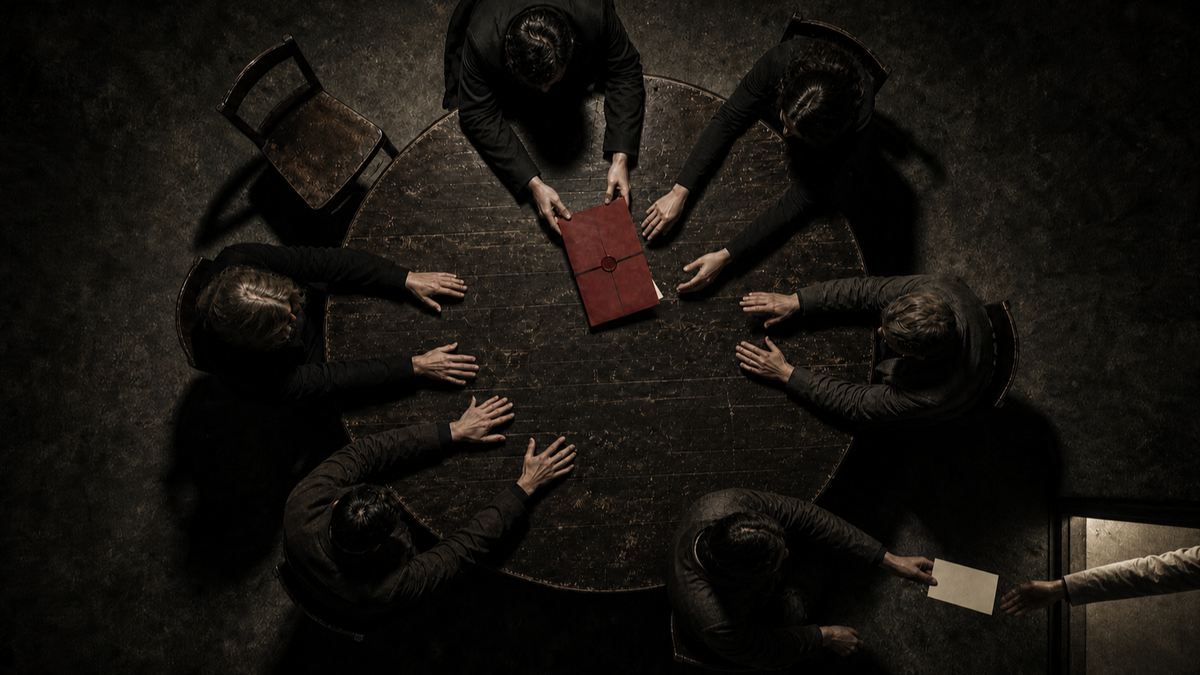
I have for many years proclaimed my allergy to conspiracy theories. Don’t get me wrong: I love a good film or television show built around a dark and elaborate conspiracy; when done well, that may, in fact, be my favorite genre. And “Us vs. Them,” my first full-length essay for Chronicles: A Magazine of American Culture (in the May 1997 issue), explored how growing distrust of the federal government in the second half of the 20th century helped create the popular appetite for such entertainment — and especially for the X-Files, then at the creative height of its conspiracy-theory mythologizing.
The best of such entertainment — think Dean Koontz in popular literature — illustrates well how fiction can draw out truths about human nature by deliberately exaggerating or even departing from reality. In the machinations of fictional conspirators, an author can explore the darkest recesses of the soul and the ways in which original sin has warped our world. Some of the best conspiracy fiction and film reminds us that evil can be surprisingly banal and that the descent into depravity often begins with the best of intentions, or at least of desires (a theme that would resonate with St. Thomas Aquinas).
The most utterly depraved characters in fiction, however (outside of explicitly satanic covens, as in Rosemary’s Baby), are rarely part of a broader conspiracy. Instead, they tend to be lone wolves, serial killers, running the range from Hannibal Lecter and Norman Bates to Michael Myers. That, too, is a way in which fiction exaggerates reality but reveals a deeper truth: The greater our sin, the less able we are to take part in any type of community. In everyday life, violent cults remain a fringe phenomenon for this very reason.
And that is where my allergy to conspiracy theories begins. Not to conspiracies: As I once wrote, no parent of more than one child could ever deny that conspiracies exist. But children’s conspiracies collapse for the same reason that the conspiracies of adults do: The effects of original sin and of their own personal sins draw them into conspiracies, but they also create the conditions that ultimately lead those conspiracies to fail or be exposed.
The elaborate conspiracy theories that have captured the imagination of significant portions of the population in recent years (think Pizzagate, QAnon, and the 2020 election) require us to believe that the depths of depravity endow a person with (or at least can be accompanied by) essentially superhuman discipline. And not just discipline or rigor that applies to himself; a significant number of serial killers (and even garden-variety sociopaths) have that.
No, the discipline that such conspirators would require in order to execute their plans successfully while keeping those plans entirely secret is a communal discipline that is morally inconsistent with the depravity that brought the conspirators together in the first place. A conspiracy theory that requires us to believe that the most clear proof of the conspiracy’s existence is that no proof of its existence can be found posits (whether the conspiracy theorist realizes it or not) that the darkness and evil that binds the conspirators together in no way affects their ability to cooperate perfectly in both executing their plans and keeping anyone outside of their cabal from learning about their actions.
Such perfect cooperation, alas, does not exist among any sizable group of Christians who are attempting to work together to do God’s will. It may exist at times (and even for significant periods of time) between a husband and wife bound together through the sacrament of matrimony, but such perfect cooperation is rarely, if ever, sustained at every moment of their married lives.[1]
This is where, logically, the most elaborate conspiracy theories break down. As a Catholic who believes in the Church’s teaching on original sin and is deeply aware of its effects in my own life, I cannot come to accept that a group of men and women drawn together by a desire to do something (much less many things) morally wrong would be able, in every one of their interactions with one another, to cooperate at a level that virtuous men and women cannot. And let’s not forget that Aquinas argued that sin distorts not only the will but reason, leading to a “blindness of the mind” that would affect the ability of the conspirators to think so clearly that they could outwit the rest of the world, even if somehow they were able to engage in perfect cooperation with one another.
Having said all of that, however, I have begun recently to rethink my position on conspiracy theories. The weak spot in my argument has always been the same as the weak spot in the argument of the conspiracy theorist: It depends on the assumption that, for a conspiracy to be successful, the conspirators must be able to prevent anyone who is not part of the conspiracy from learning of their actions.
But what would happen if the need for secrecy no longer applied? Would it be possible for a conspiracy to hide in plain sight, like Edgar Allan Poe’s purloined letter? We’ll examine that possibility next week.
We cannot say with certainty that such perfect cooperation existed at every moment even within the Holy Family. Joseph is one of the greatest saints, but the Church has never claimed that he was sinless, as was the Blessed Virgin. ↩︎