One Nation
Embracing the reality of our diversity and our common inheritance is essential to restoring true national unity.

“One nation, under God ...”
The United States is more than a country; it’s a continental empire. That reality is obvious to most people in other countries, but not to all: I have met Europeans who, upon their plane setting down at JFK Airport in New York City, started trying to figure out how to make a day trip to Wyoming to see the cowboys.
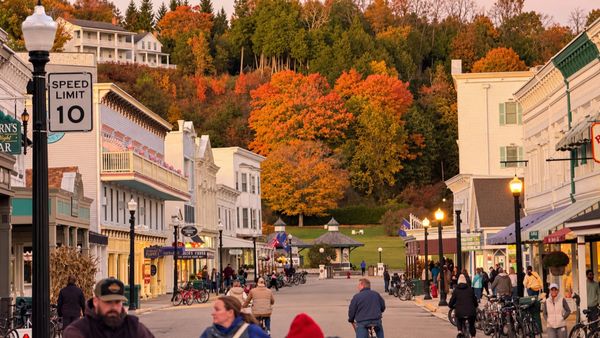
It’s not that my acquaintances didn’t understand the size of this country, at least in the abstract; but they, like we (or at least like Americans up through my generation), let the American self-understanding of one nation of 360 million people overwhelm the reality that those people are scattered across nearly 3.8 million miles. (In contrast, Italy, where my European acquaintances were from, is a mere 116,000 square miles.) Even in this age of technological communications, that geographic reality by itself works against the possibility of nationhood in the way that we understand it in Europe, and that’s before we consider the vast numbers of nationalities and ethnicities that have settled in the various corners of this continent over the course of the last 400 years, and the indigenous peoples whose own migration occurred thousands of years before that. (In the Upper Peninsula of Michigan alone, at the height of the copper boom in the second half of the 19th century, there were newspapers published in something like 27 different languages.)
Given these realities, it would be easy to swing entirely the other way, and to become convinced that there could be nothing that binds all Americans together — or, alternatively, to adopt the idea that America is merely a “proposition nation,” bound together by a few phrases from the Declaration of Independence, a founding document only in the sense that it announced the political break of the 13 original colonies from the rule of England.
But to the outside observer (and not just to my Italian friends), there’s a greater cohesion among all Americans than we ourselves are likely to acknowledge today. An Italian-descended resident of the Jersey Shore; a Tidewater Virginian or Carolinian whose ancestors were English Cavaliers; a Midwestern Catholic of German and Polish descent; a retired black manufacturing executive in Detroit, whose grandfather was a sharecropper in Alabama and whose father migrated north during World War II to work in a factory retooled to make tanks; a resident of Wyoming of Dutch extraction whose great-grandfather headed out west, inspired by the stories of Owen Wister and the experiences of Teddy Roosevelt; a New Mexican with mostly Castilian blood, whose family settled in the state two centuries before it was even a territory; a second- or third-generation Mexican-American whose family settled near Dallas; and a Californian whose Quaker grandfather migrated west from Philadelphia, whose father became an Episcopalian, and who himself has now embraced either a vague “spirituality” or become an evangelical of some stripe or other — all of these would be recognizably American to my Italian friends if they encountered them on the streets of Rome, and not just because only the Tidewater Southerner and, maybe, the Californian might have tried to learn Italian before heading overseas. (As for the denizen of the Jersey Shore? Fuhgeddaboudit.)
Our perspective colors our perception not only of ourselves but of others. Many of us would not have been able to detail the differences among the various Americans I described, but having described them, we recognize them as very different types — and yet all very American. We may not recognize ourselves personally in any one of them, but we recognize them as part of us — and thus us as part of them.
First published on July 14, 2020.