His Kingdom for a Horse
Put not your trust in princes.

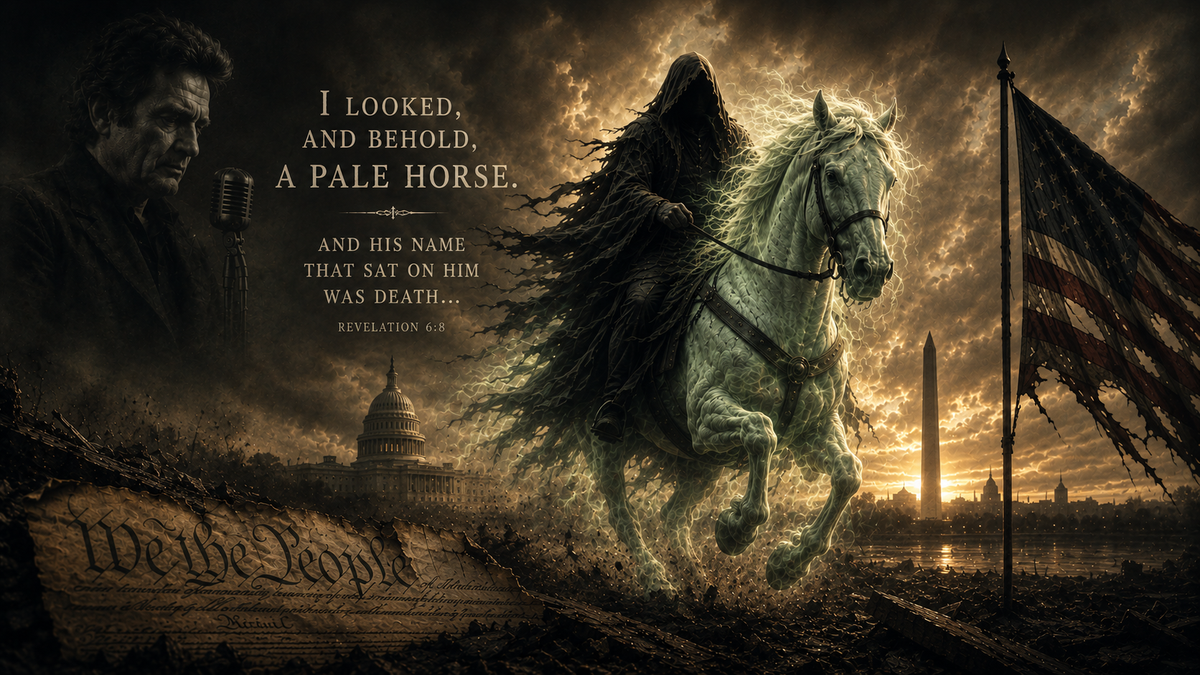
From (roughly) the mid-1980s through the end of the 1990s, there was, in the United States, a particular genre of popular conservative political literature that those who were aware of it simply called “the man on a white horse.” Representative works of this genre usually took the form of a sprawling and unedited novel that ran to hundreds of thousands of words, but occasionally appeared in short-story form. These works featured characters whose normal dialogue consisted of speeches that, in length if not in substance, were reminiscent of those delivered by the most didactic heroes in the worst books by Ayn Rand.
The stories, such as they were, established two things: The United States (and sometimes the world generally) has gone to hell in a handbasket, and the only way to restore something even vaguely resembling the constitutional order that the Framers had envisioned is the rise of a strongman — “the man on a white horse” — who, like Abraham Lincoln on steroids, would violate what remained of the Constitution in order to revive its spirit.
Some of these stories were explicitly racist and/or antisemitic, but many were not. The authors often took their inspiration from what they understood (or thought they understood) of the Pinochet regime in Chile or Franco’s rule in Spain, and sometimes a romanticized version of Mussolini’s Italy. Order was the slogan of the man on the white horse, and more often than not what he promised “the people” was to use the instruments of a government that had spiraled out of control to rein that same government back in.
That idea, of course, was always a fantasy. As Bertrand de Jouvenal, among others, has argued, Power (with a capital P) fights to preserve itself. No Christian who truly understands the effects of original sin should be surprised by this. Lord Acton declared that “Power tends to corrupt, and absolute power corrupts absolutely,” while Tolkien illustrated the point through myth and poetry: “One ring to rule them all ...”
But even the most impossible fantasies can capture the imagination, particularly when people are faced with a seemingly insoluble problem, like the exponential growth of the federal government in the late 20th century (which now seems almost quaint, compared with its growth in the first quarter of the 21st century). Part of the appeal of Pat Buchanan’s multiple campaigns for president lay in a (mostly implied) vision that he would be willing to use the instruments of big government that he criticized in order to reduce the size of the federal government. I write “mostly implied” because Pat’s vision was always closer to the original intent of the Framers, but his friends Howie Phillips and Joe Sobran, running on the Constitution Party ticket, explicitly declared that they would use the powers of the imperial presidency to return every branch of the federal government to the clear confines of the Constitution of the United States.
Knowing Howie and Joe and Pat, I could almost believe that any one of them could be the man on a white horse, were I not a Catholic and deeply aware of how easy it is to become convinced that you can use the Ring for good once you hold its power in your hands. Of course, once that thought enters your mind, the Ring begins to control you.
While the genre of “the man on a white horse” mostly died out by the turn of the millennium (in part because “serious conservatives” quit reading fiction), the impulse behind it continued to simmer. Donald Trump’s ride down the golden escalator in June 2015 brought the pot to a boil. A particular group of political thinkers who had long idolized Abraham Lincoln for saving the Constitution by transforming it saw in Trump a similar figure unbound from the conventions of conservatism and constitutionalism. Not being of particularly literary imaginations, they turned to September 11, 2001, and wrote instead of 2016 as a “Flight 93” moment, declaring that there might never be another presidential election at all if Trump were not elected.
Some of us were more cautious, even though we saw echoes of Pat Buchanan’s platform in the positions that Trump had adopted (despite Trump having called Buchanan a “Nazi” in 1999 for promoting America First economic and foreign policies). Nolite confiders in principibus: “Put not your trust in princes, in the sons of men in whom there is no salvation.” The fundamental problem with the idea of the man on a white horse is not simply the effects of original sin and the allure of Power; it’s the reality that there are no political solutions to cultural problems, and the ongoing destruction of the American constitutional order, and the centralization of power in Washington, D.C., is only superficially a political problem. In reality, it is a symptom of a culture that has lost its way, of a people whose intellects and — even more importantly — imaginations have been captured by a vision that subsumes everything human into the political sphere.
Pat Buchanan and Howie Phillips and Joe Sobran, despite their individual faults, were all good men who wanted to do the right thing and, I knew, would try their best to resist the temptation to hold on to the Ring rather than to cast it into the fires of Mount Doom. Yet I had no illusions that any of them could, in the end, live up to the vision of the man on a white horse. And if they could not, why would anyone believe that Donald Trump could?
Every generation thinks that it is living in either the best of times or the worst of times. (The historical irony of the United States in 2026 is that many people believe both simultaneously.) Saint Athanasius of Alexandria faced a world in even greater disarray, in which orthodox Christianity itself seemed on the verge of disappearing. Yet he recognized that the only way to rebuild the world around us is to start with the state of our own souls: “You cannot put straight in others what is warped in yourself.”
It’s a sobering thought, and the older I’ve become, the more I look back on my younger self and recognize the truth of Athanasius’ words. And I also realize both that they still apply and, frustratingly that one can’t be entirely objective about what is warped in oneself.
But one can, and should, and must try. And in trying, one can (through the grace of God) get better. Never perfect in this life, but better.
When a man doesn’t ever try, however, he not only never gets better at understanding what is warped in himself; he becomes increasingly worse, picking up speed like Merle Haggard’s snowball headed for hell.
There is no evidence that Donald Trump makes any effort today (if he has ever) to understand what is warped in himself. In fact, his snowball has picked up such speed that he truly seems to believe the most ridiculous things about himself — that he is, on most levels, quite literally the best man who has ever lived, smarter, more successful, more energetic, more clearsighted, more, more, more. And therefore he truly believes that those who see that the emperor has no clothes are the worst people who ever lived, to the point where he could and did post, without a shred of shame, an AI-generated image of Christ crucified, with the features subtly changed to resemble himself, and a caption that claimed that he, Donald Trump, has been more persecuted than Christ Himself.
The increasing appropriation of religious imagery by Trump and those around him, coupled with the attacks of the President and his surrogates on Pope Leo — and, through him, the Church that the Holy Father heads — is not a mere coincidence: It is the recurring pattern of the past 500 years, whenever the leaders of the political order recognize that the existence of the Church, and in particular the Catholic Church, makes it clear that there is more to life than politics. It’s no coincidence, either, that the “political philosophers” who declared 2016 “the last election that would ever matter” take Rousseau as their mentor (and some of them even embraced the term Jacobin). This may be the 250th anniversary of the signing of the Declaration of Independence, but in 2026, as the Church is experiencing a revival in France, which is preparing to welcome the first American pope this fall, the spirit of the French Revolution, and not the American one, holds sway in the Oval Office.
“A horse! A horse! My kingdom for a horse!” Shakespeare’s King Richard III cries, as he fears that a loss at Bosworth Field will mean the end of his reign. For those who truly believed that 2016 was the Flight 93 election, King Richard’s cry rang true.
Ten years later, though, some are beginning to wonder whether they may have exchanged a different kingdom for a horse they weren’t expecting: Christ’s kingdom, for a horse that only looked white through the eyes of their despair, but now appears increasingly pale green.