Incarnate Memory
Having entrusted our memories to the cloud, are we in danger of dispossessing ourselves?

This summer, we rented a dumpster with a couple of neighbors. Between three households, we filled it in two days. The company hauled it away and replaced it with an even larger dumpster. It took a little longer to fill that one, but we did it.
We have lived in our house in Huntington, Indiana, for nine years, and our oldest two children and one grandchild live in the carriage house out back. Not everything we threw away was accumulated in the last nine years. Some of it arrived in a moving truck in July 2017 from our previous home in Rockford, Illinois, and a surprising number of those boxes had never been opened. We did not resist the urge to open them before throwing them away, though we were much more ruthless than Amy and the children had been nine years ago — but even then, they had filled a massive dumpster as they prepared to join me here in Huntington.
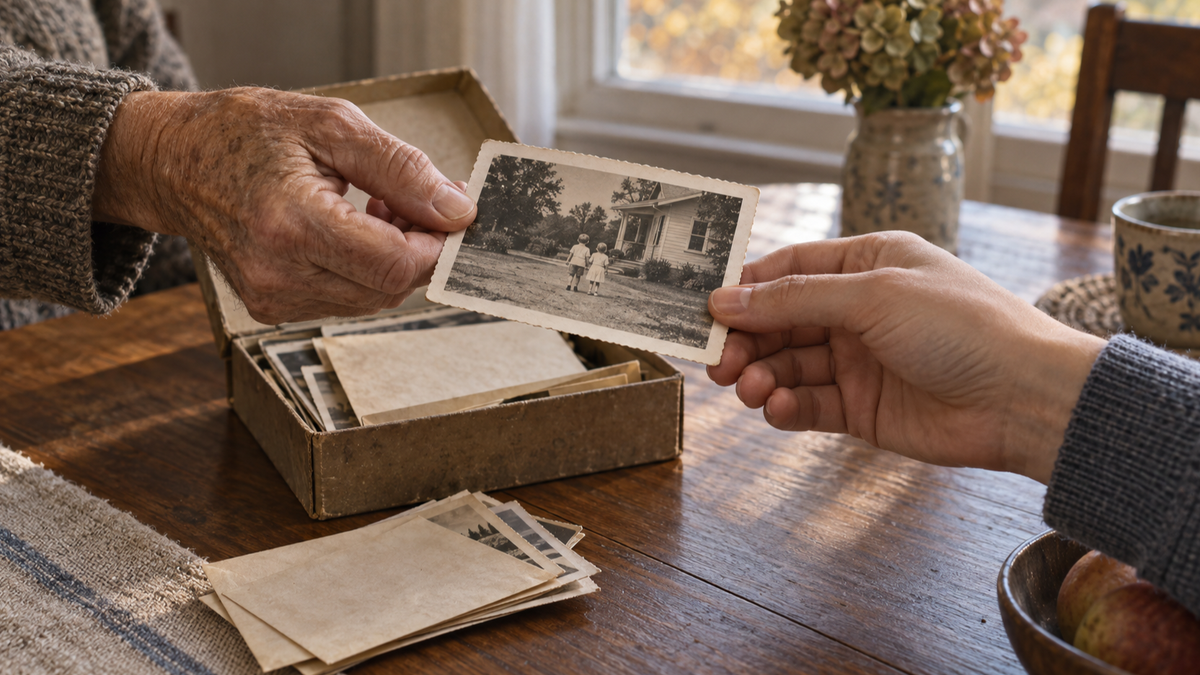
Among the items we found in those sealed boxes that we did not throw away were hundreds (if not thousands) of photographs. Perhaps 50 of them, but probably fewer, were prints we had made from digital cameras. The rest had been shot on film, from the mid-1970s until sometime shortly after 2007, on nearly every type of consumer-grade stock available over those three decades. For a while in my teens, I picked up old cameras at garage sales and the white elephant sale at our parish festival and shot film on everything from box cameras to futuristic-looking models from the 1950s and early 1960s that still had massive external flashbulbs. Those picture were in there, too.
My grandparents kept their photos in a box, but unlike the boxes we had moved from Rockford, it wasn’t sealed and stashed away. Grandma brought it out frequently at holidays or even just after Sunday dinners. Like the drawer my parents had dedicated to photos in the built-in linen closet in the hallway, Grandma’s box wasn’t well organized. As long as photos stayed in the envelopes from the drugstore where they had been taken to be developed, we had a fighting chance of being able to identify when they were taken — at least within the space of a year or so, because film was precious, and prints were expensive, so the date the film was developed rarely came within days of the dates when the photos were taken. Much of our time looking at photos was spent trying to figure out who that person was or where this was taken, or why So-and-So wasn’t in a photo that he should have been in. If we figured it out, we’d write the details on the back — sometimes. More often than not, we’d plan to do it, and then run through the whole discussion again the next time Grandma brought the box out.
My parents had a few photo albums and good intentions to fill them, and Amy and I, at one time, had the same. But as we moved to early digital cameras and then a digital SLR and finally to “the best camera” — “the one you have with you,” that is, the iPhone — we, like most people, bought into the idea that ubiquity of access to digital photos meant that we would look at them more often, and we quit printing them.
And now we mostly see them when they pop up in Facebook memories, or when something catches my eye at night in the Photo Memories widget on my iPad before Amy and I watch an episode of The Big Bang Theory. And the physical artifacts that used to draw generations together and spark conversations about long-lost relatives and friends and celebrations and trips and acted both as the catalyst for the transmission of memory and the medium for it sit sealed in boxes that only get opened when we’re looking for something to throw away.
Perhaps we’re different from most people, but I don’t think so. Everyone I know still places great value on the photos we all take, and we all believe we would be devastated if we lost them — say, through a hard drive failure or a stolen phone. And so we back them up, sometimes to CDs or DVDs or external drives that we control but mostly through iCloud or Google Photos or some other cloud service. We keep them in a digital format but outsource their storage to tech companies whose only interest in our photos is the incremental services revenue that they can report on their quarterly earnings calls.
It may be an overstatement to say that “everyone knows” that we do not truly own the music and films and TV shows and ebooks and audiobooks that we purchase from Apple and Amazon and countless other tech companies. What we have purchased is not even the particular bits and bytes that have been transferred to the storage on our devices, but a license to decode those bits and bytes and display them on our screens until such time as the conditions of the license change. Kindle users have seen books that they “owned” remotely removed from their devices (in one well-known case — irony of ironies — an edition of George Orwell’s 1984), and movies that people have “purchased” have disappeared from the iTunes Store or been replaced with edited versions. (At least in the latter case, if you had downloaded a copy, you could continue to play it; not so with the Kindle books.)
Few people realize, however, that their photos and home videos and every other kind of digital file that they have entrusted to a cloud service are in a similar precarious position. If you have all of your family photos on iCloud, set to download to your devices only when you open one, and you get hit by a bus, will your family still be able to access them? Perhaps, if they have your Apple ID and password or if you have set up a Legacy Contact in your iCloud account. Otherwise, there’s a good chance that they will never see those photos again, other than the ones scattered here or there on social media or the few you may have actually printed out.
Those photos and videos and all of your Microsoft Word documents and PDFs and any other digital files that you have stored in the cloud are undoubtedly yours, and legally they may pass to your heirs, but legal ownership means nothing if your family cannot take possession of them. You don’t even need to die to find yourself in a similar situation. Just let your subscription lapse or make a mistake when changing your password, and see how easy it is to recover “your” property.
My purpose is not to write a tutorial on how to ensure that your photos and files remain yours and can be passed down to your family — you can find scores of such tutorials online; read them, and make a plan — but to explore the implications of the transition from physical media to digital media, and from ownership to subscription, on personal memory and the broader culture.
Earlier, I mentioned that the ubiquity of access to digital photos has had a very different effect from the one most of us expected. We continue to take photos — more than ever before — but the fact that we know that we can view them at any time from any device connected to the internet has meant that we are less likely at any given moment to look at them, and certainly less likely to print them out or to sit with others and discuss them. Even before we consider that our access to our photos may disappear at any time, the chief function that printed photos served from the 19th century on — the capturing of a moment in time in order to remember it and to pass that memory on to others — has been diminished, attenuated, by the change in medium.
Physical books, magazines, even more ephemeral print products such as newspapers — their corporeality made them better suited to the ongoing transmission of their contents than any form of digital media. Their contents: not simply content, the abstract term for any bit or bob of visual or auditory or textual information that one person creates and another “consumes,” but the ideas and narratives and images that were important enough to be worth the time and the effort not just to think them or write them or draw them or photograph them but to embody them in a physical object with the intention that they would endure for the sake of others, and not just for oneself.
The effort required to put into print a book or a magazine or a newspaper or even just a photo gave that item value. When I was the Catholicism Expert for About.com, I had certain articles that racked up millions of pageviews, something that would not have been possible had they appeared in print. On the surface, then, it may seem that removing the friction required to share a thought is an unqualified good. But there’s a reason why every parent has told his or her children that they don’t need to say everything that enters their minds. Inflation, as John Lukacs warned, is not just a monetary phenomenon; it can be an affliction of the intellect and, therefore, of culture as well.
The more there is of any type of item, the less valuable any single item of that type becomes. The more easily “content” can be obtained, the less likely we are to value any particular bit of content enough to pay for it. And when all content has become essentially free, the less likely we are to discern any difference between that which has intrinsic value and a grainy security camera video of a drunken raccoon having the time of its life while trapped in a liquor store.
The devaluation of “content” in the culture at large affects the way we think about our own property — those digital photos and videos and documents we have produced and filed away, out of sight, out of mind. We can revisit them at any time, so we don’t. We can show them to our children whenever we want, so we never do. We can print them and frame them and hang them on the wall next week, next month, next year, so the walls of our homes remain bare, and the walls of our children’s and grandchildren’s memories never become adorned with anything beyond that which they have personally experienced, and even those memories fade over time without visible reminders that they occurred.
A credit card payment fails; a man changes his password and forgets to tell his wife and a few days later passes away in his sleep; and eventually the bits and bytes of his life and his family’s life that he stored safely in the cloud are deleted, and the lack of malice on the part of the company to which he entrusted his memories only makes the loss more poignant and more pointless. The promise of eternal memory through digital storage in the cloud turns out to be as empty as any of Satan’s lies.
We are incarnate creatures, and thus our memories — personal, familial, cultural — are bound up with material things. In theory, the digitization of old books and photos and other media is a good thing, preserving materials that might otherwise have been lost. But the very fact that I could not find a better word to use in that last sentence than materials makes the problem clear. When material becomes content but content never becomes material again, how can we continue to transmit memory from person to person and generation to generation?
The Countermarch is a labor of love. If you found this essay thought-provoking or useful, please consider supporting the site.